







Strategy Execution: How Technical Analysis Shapes Smarter Trading Decisions
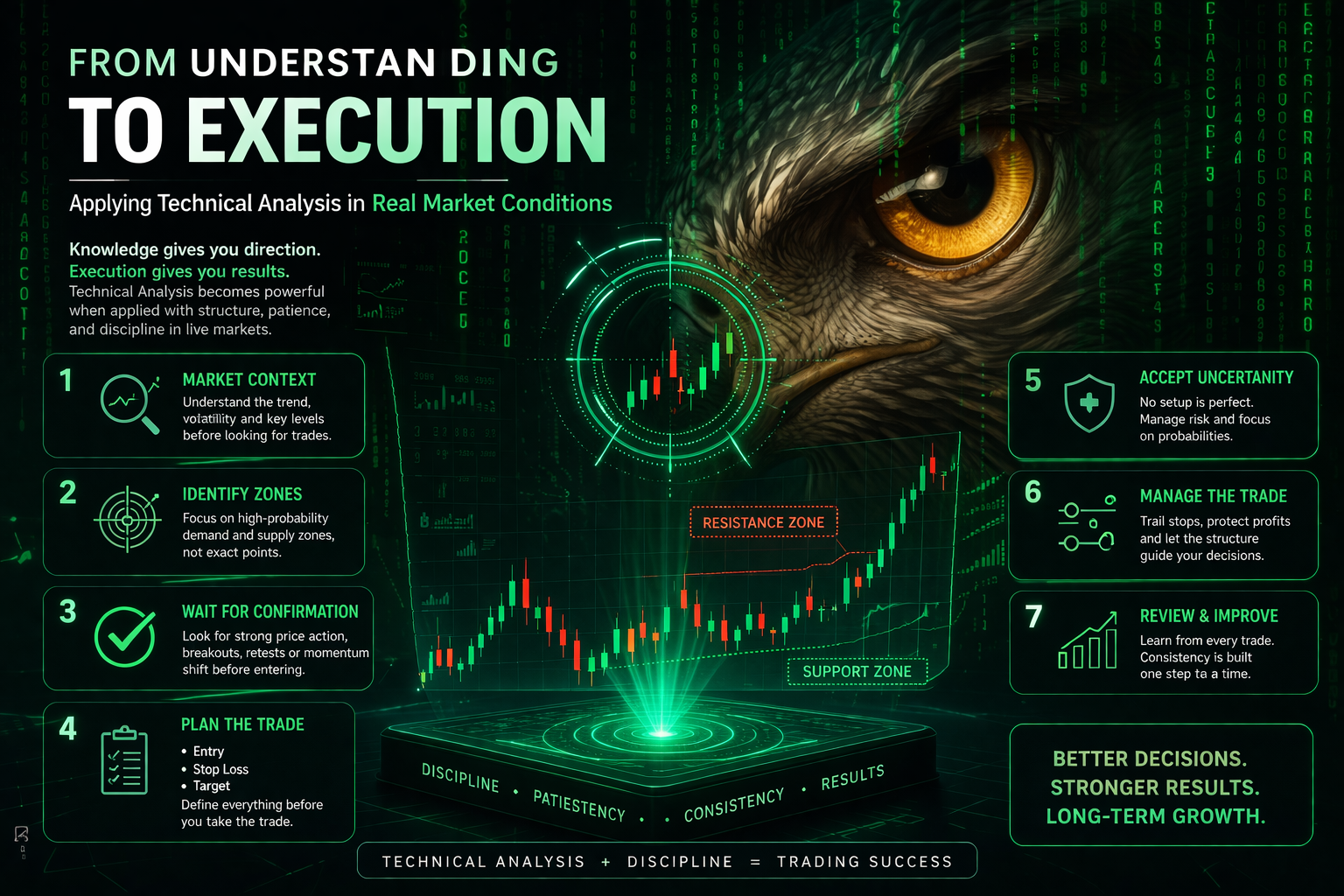
In today’s fast-moving financial markets, success is rarely about reacting quickly — it is about observing clearly and acting with structure. The image above captures this idea in a powerful and symbolic way, blending the sharp focus of a hawk with a high-tech, data-driven trading environment.
At its core, this visual represents the journey every trader must take — moving from understanding technical analysis to actually executing trades with discipline and clarity.
The Hawk’s Eye: A Symbol of Focus and Precision
The most striking element in the image is the hawk’s eye. This is not just a design choice — it represents a mindset.
A hawk does not react to every movement. It observes patiently, tracks patterns, and strikes only when the moment is right.
This is exactly how technical analysis should be approached.
In trading, clarity comes from:
-
Observing price behavior carefully
-
Identifying patterns over time
-
Waiting for the right opportunity
The hawk’s eye in the image, enhanced with a matrix-like data overlay, symbolizes the ability to filter noise and focus only on what matters.
The Matrix Layer: Understanding Market Complexity
The green, matrix-style background reflects the complexity of financial markets.
Markets are influenced by countless variables:
-
Global events
-
Economic data
-
Market sentiment
-
Institutional activity
At first glance, it may all seem chaotic.
However, technical analysis helps convert this complexity into something structured. Instead of trying to understand everything, it focuses on one key element — price behavior.
The matrix theme represents:
-
Data flow
-
Continuous market activity
-
Hidden patterns beneath the surface
And technical analysis acts as the tool that helps decode it.
Charts and Structure: The Language of the Market
In the image, multiple charts and graphical elements are displayed across screens and within the hawk’s eye.
These charts represent the language of the market.
Every candlestick, every trendline, and every breakout tells a story:
-
Where buyers are active
-
Where sellers are stepping in
-
Where momentum is building or fading
Technical analysis allows traders to interpret this language.
Instead of relying on opinions or predictions, it shifts focus to:
-
What the market is actually doing
-
How price is reacting at key levels
-
Whether a trend is strengthening or weakening
From Understanding to Execution
One of the key messages highlighted in the visual is the transition:
From Understanding → To Execution
This is where many traders face difficulty.
Learning technical concepts is one thing:
-
Support and resistance
-
Trend analysis
-
Indicators
But applying them in real-time is another challenge entirely.
Execution requires:
-
Confidence in your analysis
-
Discipline to follow your plan
-
Patience to wait for the right setup
The image emphasizes that knowledge alone is not enough — it must be combined with action, guided by structure.
The Role of Structured Decision-Making
On the left side of the visual, there are step-based elements that outline a clear process:
-
Understanding market context
-
Identifying key zones
-
Waiting for confirmation
-
Planning the trade
-
Managing risk
-
Reviewing performance
This structured approach is the foundation of effective technical analysis.
Instead of random decisions, traders follow a repeatable process:
-
Analyze
-
Plan
-
Execute
-
Review
Over time, this consistency leads to better outcomes.
Discipline Over Emotion
Another key takeaway from the image is the emphasis on discipline.
Markets can trigger strong emotions:
-
Fear when price moves against you
-
Greed when a trade is in profit
-
Impulsiveness when opportunities seem to appear suddenly
Technical analysis, when applied correctly, acts as a stabilizing force.
By defining:
-
Entry points
-
Stop-loss levels
-
Target zones
you reduce the need for emotional decision-making.
The message is clear:
Discipline and structure are more powerful than speed and reaction.
Technology Meets Human Judgment
The image also highlights the combination of:
-
Advanced tools (charts, data, screens)
-
Human decision-making (the trader observing and analyzing)
This balance is important.
While tools and indicators provide information, the interpretation still depends on the trader.
Technical analysis is not about blindly following indicators — it is about:
-
Understanding context
-
Interpreting signals
-
Making informed decisions
Consistency: The Real Edge
The phrase at the bottom of the image reinforces an important idea:
Technical Analysis + Discipline = Trading Success
This does not mean every trade will be successful.
Instead, it highlights that:
-
Consistent application of a structured approach
-
Combined with disciplined execution
can lead to better long-term outcomes.
Success in trading is not about one perfect trade — it is about repeating a process effectively over time.
A Learning Perspective
For someone new to markets, this image serves as a roadmap.
It suggests:
-
Start by understanding basic concepts
-
Observe charts regularly
-
Learn how price behaves
-
Gradually build a structured approach
And most importantly:
-
Avoid rushing into decisions
-
Focus on learning, not just outcomes
Final Thoughts
This visual is more than just a design — it is a representation of how technical analysis should be approached.
It brings together:
-
The focus of a hawk
-
The complexity of market data
-
The structure of technical analysis
-
The discipline required for execution
In a market environment filled with constant noise, the ability to observe clearly and act with intention becomes a significant advantage.
Technical analysis, when combined with patience and structure, helps you move from:
-
Confusion → Clarity
-
Reaction → Planning
-
Randomness → Consistency
And over time, that shift can redefine how you experience and understand the markets.
This content is for educational purposes only and does not constitute investment advice.


Post Comment