(A Practical Guide to Strong Fundamental Research)
In today’s information-heavy market environment, success is no longer about access to data — it is about how effectively you interpret it.
With thousands of stocks, constant news flow, and changing market conditions, many investors feel overwhelmed. This is where fundamental research becomes a reliable and structured approach.
Fundamental research is not about predicting short-term price movements. It is about understanding the true strength, sustainability, and long-term potential of a business.
In this article, we explore reliable solutions and data-driven methods to elevate your stock research process using fundamental analysis.
Why Fundamental Research Matters More Than Ever
Modern markets are driven by:
According to global market studies:
This highlights one thing clearly:
Strong businesses drive long-term performance — not short-term noise.
The Foundation of Reliable Stock Research
To simplify your approach, focus on structured and repeatable analysis.
Instead of chasing multiple metrics, concentrate on core data points that truly matter.
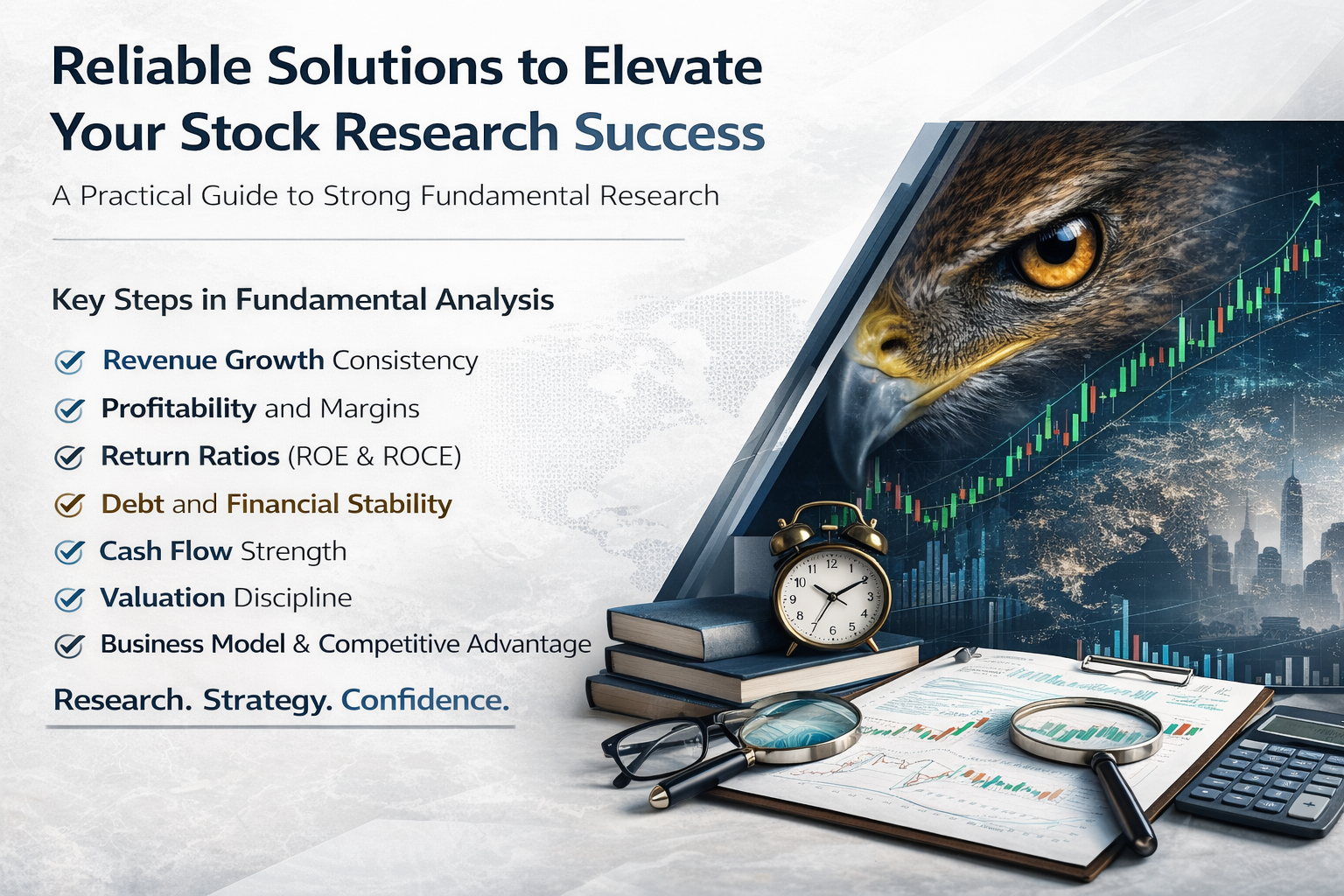
1. Revenue Growth Consistency
Revenue is the starting point of all analysis.
What data shows:
What to check:
Reliable businesses show consistent top-line growth.
2. Profitability and Margins
Revenue without profit is incomplete.
Key metrics:
-
Net Profit Margin
-
Operating Margin
Data insight:
Example:
Profitability reflects efficiency and business strength.
3. Return Ratios (ROE & ROCE)
Return ratios measure how effectively a company uses capital.
Key benchmarks:
Why it matters:
4. Debt and Financial Stability
Debt is a critical factor often overlooked.
Data insights:
Key metric:
Ideal scenario:
-
Low or manageable debt
-
Strong interest coverage
5. Cash Flow Strength
Cash flow is one of the most reliable indicators of business health.
Important observation:
Data point:
Cash flow confirms whether profits are real and sustainable.
6. Valuation Discipline
Even the best company can be a poor investment at the wrong price.
Key metric:
Data perspective:
Always compare:
-
Industry averages
-
Growth expectations
7. Business Model & Competitive Advantage
Numbers alone are not enough.
You must understand:
Strong indicators:
-
Market leadership
-
Brand value
-
Entry barriers
Businesses with strong advantages tend to sustain long-term growth.
A Reliable Framework for Fundamental Research
To simplify your workflow, follow this structured process:
Step 1: Screen Companies
Filter based on:
-
Revenue growth
-
Profitability
-
Debt levels
Step 2: Analyze Financial Strength
Focus on:
Step 3: Evaluate Valuation
Check if the price aligns with business quality.
Step 4: Understand the Business
Study:
-
Industry trends
-
Competitive landscape
Step 5: Track Over Time
Fundamental research is not one-time — it is continuous.
Real-World Insight: Why Fundamentals Matter
Across global markets:
Example trend:
This reinforces the importance of quality over hype.
Common Mistakes in Fundamental Research
Overloading with Data
Too many metrics create confusion — focus on core indicators.
Ignoring Consistency
One good quarter does not define a strong company.
Chasing Trends
Market trends change — business fundamentals matter more.
Ignoring Valuation
Even strong companies can underperform if overpriced.
Elevating Your Research Approach
To truly improve your stock research:
-
Stay consistent with your analysis
-
Focus on long-term trends, not short-term noise
-
Build a checklist-based approach
-
Continuously learn and refine
Final Thoughts
Reliable stock research is not about complexity — it is about clarity and consistency.
By focusing on:
-
Revenue growth
-
Profitability
-
Return ratios
-
Debt
-
Cash flow
-
Valuation
-
Business quality
you create a strong foundation for fundamental research.
Over time, this structured approach helps you:
In a market full of noise, reliable solutions come from disciplined thinking and structured analysis.
Keyword Covered:
Fundamental Research, Stock Research Strategy, Financial Analysis, ROE, Cash Flow Analysis, Valuation Metrics, Long-Term Investing
This content is for educational purposes only and does not constitute investment advice.




















Post Comment