








RBI MPC June 2026: Critical Repo Rate Decision at 5.25% – Powerful Insights for Investors
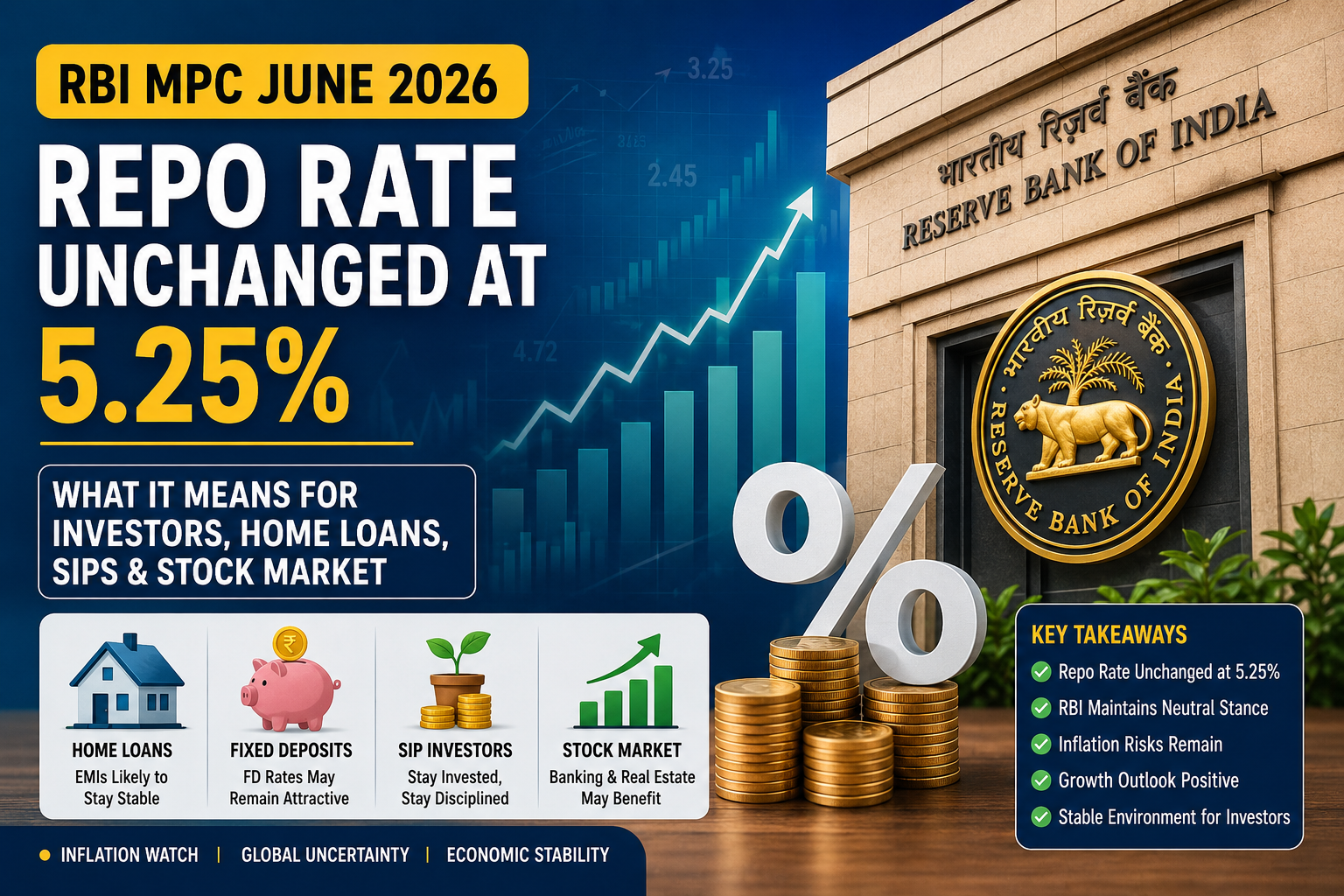
RBI MPC June 2026: Key Policy Highlights
- Repo Rate remains unchanged at 5.25%
- RBI maintains neutral policy stance
- Inflation remains under close watch
- Home loan EMIs likely to remain stable
- FD rates expected to stay attractive
- Positive long-term outlook for investors
Historical RBI Repo Rate Trend (2020-2026)
| Year | Repo Rate |
|---|---|
| 2020 | 4.00% |
| 2021 | 4.00% |
| 2022 | 4.40% - 6.25% |
| 2023 | 6.50% |
| 2024 | 6.50% |
| 2025 | 5.50% |
| 2026 | 5.25% |
What is the Repo Rate and Why Does It Matter?
The repo rate is the interest rate at which commercial banks borrow funds from the Reserve Bank of India. It acts as the benchmark for lending rates across the financial system.
| RBI Action | Impact on Borrowing | Economic Effect |
|---|---|---|
| Repo Rate Cut | Cheaper Loans | Supports Growth |
| Repo Rate Increase | Costlier Loans | Controls Inflation |
| No Change | Stable EMIs | Economic Balance |
Whenever the RBI changes the repo rate, banks eventually adjust lending and deposit rates, affecting millions of households and businesses.
Why Did RBI Keep Rates Unchanged?
In our view, the RBI's decision reflects caution rather than indecision.
1. Inflation Risks Continue
Although inflation has moderated compared to previous peaks, food prices, fuel costs, and supply chain disruptions continue to create uncertainty.
2. Rising Crude Oil Prices
India imports a substantial portion of its energy requirements. Any increase in global crude oil prices directly affects transportation, logistics, and manufacturing costs.
3. Global Economic Uncertainty
Ongoing geopolitical tensions and changing trade dynamics continue to influence financial markets worldwide.
4. Supporting Economic Stability
The RBI appears focused on creating a stable environment for businesses and consumers rather than making aggressive monetary policy moves.
Economic Factors Influencing RBI Decisions
| Inflation | ★★★★☆ |
| Crude Oil Prices | ★★★★☆ |
| Global Risks | ★★★★☆ |
| Economic Growth | ★★★☆☆ |
| Currency Stability | ★★★☆☆ |
Illustrative representation based on market observations and policy commentary.
India's Economic Outlook: Stable but Vigilant
India continues to remain one of the fastest-growing major economies globally. Strong domestic consumption, infrastructure investment, and digital adoption continue to support growth.
However, investors should remember that economic growth does not occur in isolation. Commodity prices, inflation, and international developments can influence the pace of expansion.
What Does This Mean for Investors?
For Equity Investors
Stable interest rates generally create a supportive environment for corporate earnings and investor sentiment.
For Fixed Deposit Investors
FD investors can continue enjoying current interest rate levels without major disruptions.
For Retirement Investors
Long-term retirement planning should remain focused on asset allocation and inflation-adjusted returns.
For Mutual Fund Investors
A disciplined SIP strategy remains one of the most effective ways to build wealth irrespective of short-term policy decisions.
Stock Market Impact Analysis
| Sector | Potential Impact | Investor View |
|---|---|---|
| Banking | Positive | Stable lending environment |
| Real Estate | Positive | Affordable borrowing costs |
| Infrastructure | Moderately Positive | Supports project financing |
| Consumer Goods | Neutral to Positive | Stable spending patterns |
| IT Services | Neutral | Global demand remains key |
Key Economic Snapshot
| Indicator | Status |
|---|---|
| Repo Rate | 5.25% |
| Policy Stance | Neutral |
| Inflation Outlook | Moderately Elevated |
| Growth Outlook | Positive |
| Market Sentiment | Stable |
Should SIP Investors Change Strategy?
Our answer is simple: No.
One RBI policy announcement should never determine your long-term investment strategy. SIP investing works because it removes emotional decision-making and allows investors to benefit from compounding over time.
Many investors who consistently invested during periods of uncertainty have historically generated superior long-term returns compared to those attempting to time the market.
Author's View
At Mint & Print Financial Services, we believe investors should pay more attention to long-term trends than short-term policy headlines.
The latest RBI decision reinforces an important investing principle: wealth creation is driven by consistency, discipline, and quality investments rather than predicting every interest-rate movement.
Useful References
- Reserve Bank of India (RBI)
- SEBI
- National Stock Exchange
- Bombay Stock Exchange
- World Bank
- International Monetary Fund
Frequently Asked Questions (FAQs)
1. What was the key outcome of the RBI MPC June 2026 meeting?
The RBI MPC June 2026 meeting concluded with the Reserve Bank of India keeping the repo rate unchanged at 5.25%. This decision reflects the RBI's focus on balancing inflation control with economic growth. The latest RBI Policy Update suggests that policymakers are closely monitoring global economic developments, crude oil prices, and domestic inflation before making future changes to the repo rate.
2. Why did RBI keep the repo rate unchanged in RBI MPC June 2026?
The RBI MPC June 2026 decision was influenced by inflation concerns, global uncertainty, and the need to maintain financial stability. By keeping the repo rate unchanged, the RBI aims to support sustainable growth while ensuring inflation remains under control. The latest RBI Policy Update highlights the importance of stability in the current economic environment.
3. How does RBI MPC June 2026 affect home loan borrowers?
For most borrowers, the RBI MPC June 2026 outcome means that Home Loan EMI payments are likely to remain stable in the near term. Since banks often link lending rates to the repo rate, no immediate increase in borrowing costs is expected. This stability helps homebuyers plan their finances with greater confidence.
4. Will Home Loan EMI payments reduce after RBI MPC June 2026?
The current RBI MPC June 2026 decision does not directly reduce Home Loan EMI obligations because the repo rate remains unchanged. However, future RBI MPC meetings could consider rate cuts if inflation moderates and economic conditions support monetary easing.
5. What is the impact of RBI Repo Rate 2026 on SIP Investments?
The RBI Repo Rate 2026 influences liquidity, borrowing costs, and investor sentiment. However, long-term SIP Investments should not be altered solely because of one policy decision. Investors who continue SIP Investments consistently often benefit from compounding and rupee-cost averaging over time.
6. Should investors stop SIP Investments after RBI MPC June 2026?
No. The RBI MPC June 2026 announcement should not change a disciplined investment approach. Most wealth creation occurs through consistent SIP Investments, proper asset allocation, and long-term planning rather than reacting to short-term RBI Policy Updates.
7. How does RBI MPC June 2026 affect the Stock Market?
The Stock Market generally reacts positively to policy stability. The RBI MPC June 2026 decision provides clarity for businesses and investors, reducing uncertainty. Banking, infrastructure, and real estate sectors often benefit when interest rates remain predictable.
8. Which sectors may benefit from RBI MPC June 2026?
Following the RBI MPC June 2026 announcement, banking, real estate, infrastructure, consumer goods, and automobile sectors could benefit from stable borrowing conditions. A steady repo rate allows companies to plan expansion and capital investments more effectively.
9. How are Fixed Deposit Rates affected by RBI MPC June 2026?
The latest RBI MPC June 2026 outcome means Fixed Deposit Rates are likely to remain relatively stable. Since banks adjust deposit rates based on broader interest-rate trends, an unchanged repo rate reduces the chances of sudden changes in Fixed Deposit Rates.
10. Is RBI Repo Rate 2026 good for Fixed Deposit investors?
For conservative investors, the current RBI Repo Rate 2026 environment offers stability. While Fixed Deposit Rates may not rise sharply, investors continue to enjoy predictable returns and lower interest-rate volatility compared with previous economic cycles.
11. What role does inflation play in RBI MPC June 2026 decisions?
Inflation remains one of the most important considerations for the RBI MPC June 2026. The RBI uses the repo rate to influence borrowing costs and demand within the economy. If inflation rises significantly, future RBI MPC Meetings could adopt a more restrictive policy stance.
12. Why is the Repo Rate important for the Indian economy?
The repo rate impacts lending rates, Home Loan EMI costs, business borrowing, consumer spending, Fixed Deposit Rates, and investment activity. Every RBI Policy Update therefore receives close attention from investors, businesses, and financial institutions across India.
13. How does RBI MPC June 2026 affect mutual fund investors?
The RBI MPC June 2026 decision may influence debt mutual funds through interest-rate expectations, while equity mutual funds are more affected by earnings growth and economic conditions. Long-term investors should focus on diversification and continue SIP Investments according to their financial goals.
14. Should long-term investors worry about RBI MPC June 2026?
Long-term investors should avoid overreacting to the RBI MPC June 2026 announcement. Wealth creation is driven by disciplined investing, quality assets, and time in the market rather than predicting every change in the RBI Repo Rate 2026 environment.
15. How often does the RBI MPC Meeting take place?
The RBI MPC Meeting is generally conducted six times during a financial year. Each RBI MPC Meeting evaluates inflation, growth, liquidity, global developments, and financial stability before determining the appropriate repo rate policy.
16. What indicators should investors monitor after RBI MPC June 2026?
Investors should monitor inflation trends, GDP growth, crude oil prices, corporate earnings, employment data, and future RBI Policy Updates. These factors often have a larger influence on long-term investment returns than a single RBI MPC June 2026 decision.
17. Can RBI MPC June 2026 influence retirement planning?
Yes. The RBI MPC June 2026 outcome affects fixed-income investments, pension products, and retirement portfolios. Investors planning retirement should ensure their portfolios generate returns that can outpace inflation over the long term.
18. How does RBI MPC June 2026 impact business loans?
Because the repo rate remains stable, businesses can continue borrowing under predictable conditions. The RBI MPC June 2026 decision supports financial planning, capital expenditure, and long-term expansion strategies for companies across multiple sectors.
19. Is RBI MPC June 2026 positive for economic growth?
Many economists view the RBI MPC June 2026 decision as supportive of economic stability. A stable repo rate helps maintain confidence among businesses and consumers while allowing the RBI to respond flexibly to future inflationary pressures.
20. What is the biggest lesson from RBI MPC June 2026 for investors?
The most important lesson from RBI MPC June 2026 is that successful investing depends on discipline, diversification, and patience. Whether investing through SIP Investments, mutual funds, stocks, retirement plans, or Fixed Deposits, long-term success comes from staying focused on financial goals rather than reacting to short-term market headlines.
Final Thoughts
The RBI's June 2026 policy decision may not have delivered dramatic changes, but it provided something equally valuable — stability.
For investors, borrowers, and businesses, stable monetary policy creates an environment where long-term financial planning becomes easier. Rather than reacting to headlines, investors should continue focusing on quality assets, disciplined SIP investing, retirement planning, and portfolio diversification.
In our view, wealth is not created by predicting every RBI move. Wealth is created through patience, consistency, and informed decision-making.












Post Comment