New

Will Market Crash in 2026? (Shocking Signals Investors Must Know)

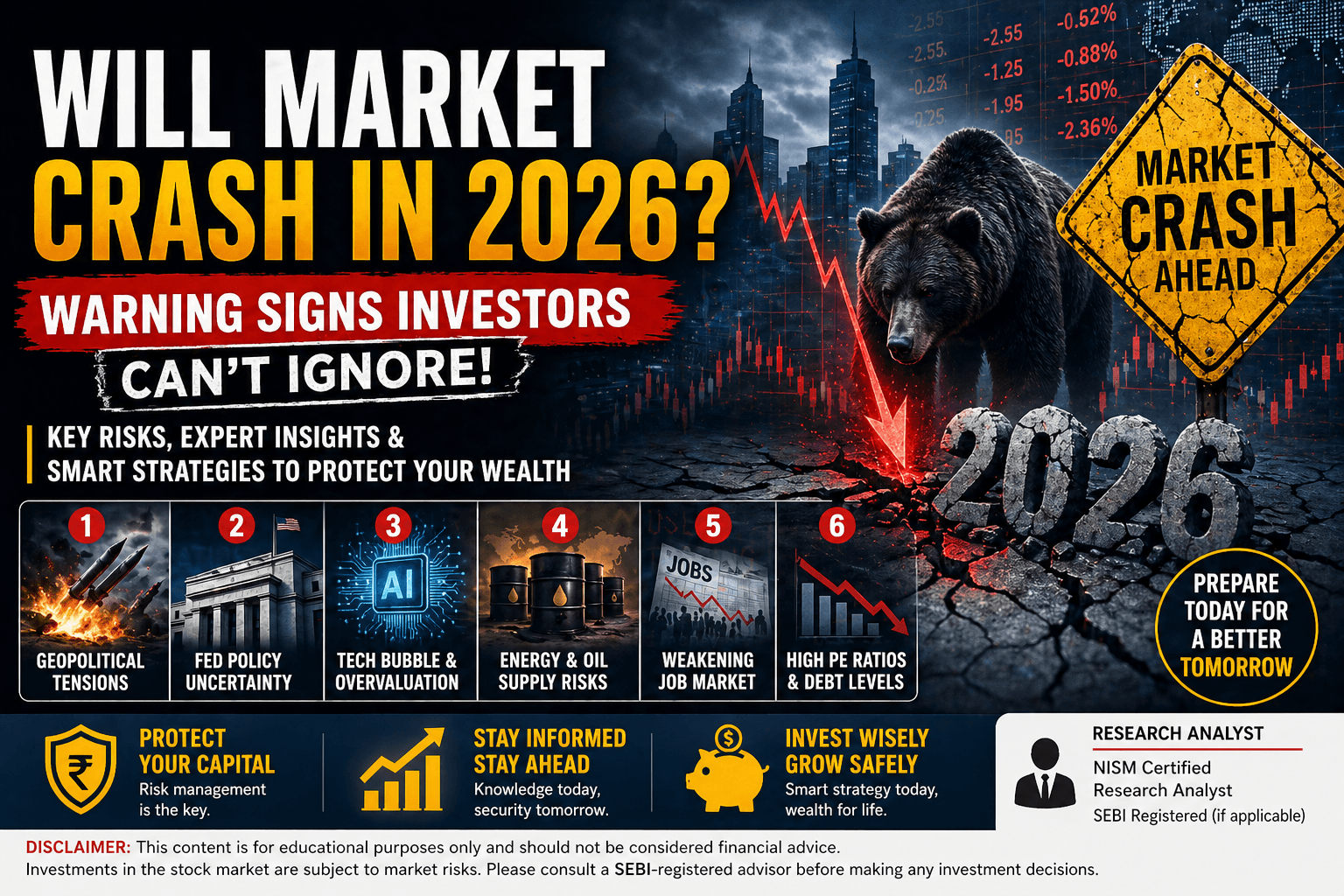
Will market crash in 2026 warning signs showing stock market crash risks including geopolitical tensions, high PE ratios, AI bubble and falling markets

Will Market Crash in 2026?

Introduction :

Will market crash in 2026? That’s the question every investor—from beginners in India to seasoned traders in the USA—is asking right now. With rising geopolitical tensions, record-high stock valuations, and signals from legendary investors like Warren Buffett, the fear of a stock market crash in 2026 is becoming impossible to ignore.

But here’s the truth: markets don’t crash randomly. They leave clues.

In this blog, we break down:

  • Real data-backed signals
  • Global economic risks
  • Buffett Indicator warning
  • Expert insights
  • What YOU should do next

What Does “Market Crash” Really Mean?

stock market crash is a sudden, sharp drop in stock prices—usually 20% or more—within a short period.

Key Characteristics:

  • Panic selling
  • Massive wealth erosion
  • Liquidity crunch
  • Investor fear dominates logic

Examples:

  • 2008 Financial Crisis
  • 2000 Dot-Com Bubble
  • 2020 COVID Crash

Will Market Crash in 2026?

Yes, the probability of a market correction or crash in 2026 is rising due to:

  • Extremely high valuations
  • Geopolitical instability
  • Interest rate uncertainty
  • Overconcentration in tech stocks
  • Economic imbalance

But timing is uncertain.

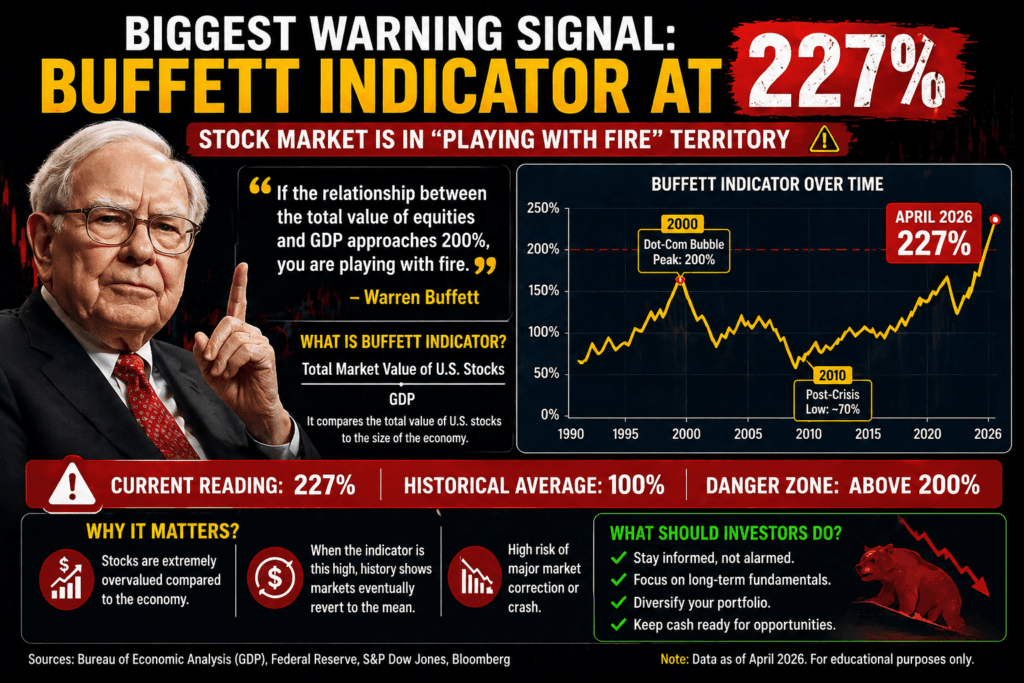
Biggest Warning Signal: Buffett Indicator at 227%

One of the strongest arguments supporting the “Will market crash in 2026” debate comes from the Buffett Indicator.

What is Buffett Indicator?

It compares:

Total stock market value ÷ GDP

Why it matters:

  • 70–80% → Undervalued
  • 100–120% → Fair value
  • 200%+ → Danger zone 

Current Situation (2026):

  • Indicator: ~227%
  • Historical average: ~100%

This means markets are heavily overvalued

Buffett’s Warning:

“If it approaches 200%, you are playing with fire.”

Buffett Indicator at 227 percent showing extreme stock market overvaluation and warning signs of potential market crash in 2026
The Buffett Indicator has crossed 227%, signaling that the stock market may be in a dangerous overvaluation zone.

6 Major Risk Factors That Could Trigger a Market Crash in 2026

Geopolitical Tensions (Iran Conflict)

Global markets hate uncertainty.

Current risks:

  • Middle East war escalation
  • Oil supply disruption
  • Rising inflation

Impact:

  • Higher fuel costs
  • Reduced global growth
  • Market panic

Federal Reserve Policy Confusion

Markets depend heavily on interest rates.

Current situation:

  • Inflation still above comfort levels
  • Pressure for rate cuts
  • Political influence increasing

Risk:

  • Wrong rate decisions = market instability

Tech Sector Overdependence

A huge chunk of market growth is coming from:

  • AI companies
  • Big Tech
  • Semiconductor sector

Problem:

  • If tech slows → entire market falls


High P/E Ratios (Overvaluation)

Current:

  • S&P 500 P/E: 28+
  • Historical average: ~17

Meaning:
Stocks are priced for perfection

Risk:

  • Any bad news → sharp correction

Energy Market Risk

Middle East controls:

  • ~20% global oil supply

If disrupted:

  • Inflation rises
  • Production costs increase
  • Markets crash faster


Job Market Weakness

Early signs:

  • Layoffs increasing
  • Hiring slowing

Why it matters:

  • Jobs drive spending
  • Spending drives economy

Weak jobs = recession risk


Hidden Risk: AI Bubble Formation

AI is booming—but that’s also a risk.

Why?

  • Massive capital inflow
  • High expectations
  • Uncertain long-term ROI

Similar to:

  • Dot-com bubble (2000)

India vs USA: Who Is More at Risk?

🇺🇸 USA:

  • High valuations
  • Tech-heavy market
  • Global exposure

Higher crash risk

🇮🇳 India:

  • Strong domestic demand
  • Growing economy
  • Retail investor boom

Moderate risk but not immune

Can Markets Still Go Up in 2026?

Yes.

Even in risky conditions:

  • Earnings growth continues
  • AI investments rising
  • Liquidity still present

Markets can stay irrational longer than expected


What Smart Investors Should Do Now

1. Diversify Portfolio

  • Equity + Gold + Bonds

2. Avoid Overleveraging

  • Stay away from margin trading

3. Focus on Fundamentals

  • Strong companies only

4. Keep Cash Ready

  • Crashes = buying opportunity

5. Think Long-Term

  • Short-term volatility is normal

Where Should You Invest in 2026?

Short-Term:

  • Liquid funds
  • Fixed deposits
  • Money market

Medium-Term:

  • Bonds
  • Hybrid funds

Long-Term:

  • Index funds
  • Blue-chip stocks
  • Gold

Expert Insight (Research Analyst Perspective)

Amit K Sharma – (Founder Desk)

NISM Certified Research Analyst

“Markets in 2026 are clearly stretched. While a crash is not guaranteed, the probability of a correction is high. Investors should focus on risk management instead of chasing returns.”

FAQs

1. Will market crash in 2026 for sure?

No, but risks are significantly higher than normal.


2. What is the biggest warning sign right now?

Buffett Indicator above 200%.

3. Should I exit the market now?

Not completely. Reduce risk, don’t panic sell.


4. Is India safe from a global crash?

No. India is linked to global markets.


5. Which sector is most risky?

Technology and AI-driven stocks.


6. Can war cause a stock market crash?

Yes. Wars increase uncertainty and inflation.


7. What is a safe investment during a crash?

Gold, bonds, and cash reserves.


8. Should beginners invest in 2026?

Yes, but via SIP and long-term strategy.


9. How much correction is possible?

10%–30% depending on severity.


10. What is the best strategy now?

Stay invested + diversify + avoid panic.


Conclusion: Reality Check for Investors

So, will market crash in 2026?

  • The warning signs are real
  • The risks are building
  • But timing remains uncertain

The smartest move right now is not predicting the crash—but preparing for it.


Disclaimer

This content is for educational purposes only and should not be considered financial advice. Please consult a SEBI-registered or certified financial advisor before making any investment decisions. Investments in the stock market are subject to market risks.
Related Articles :

Share this content:

Post Comment