








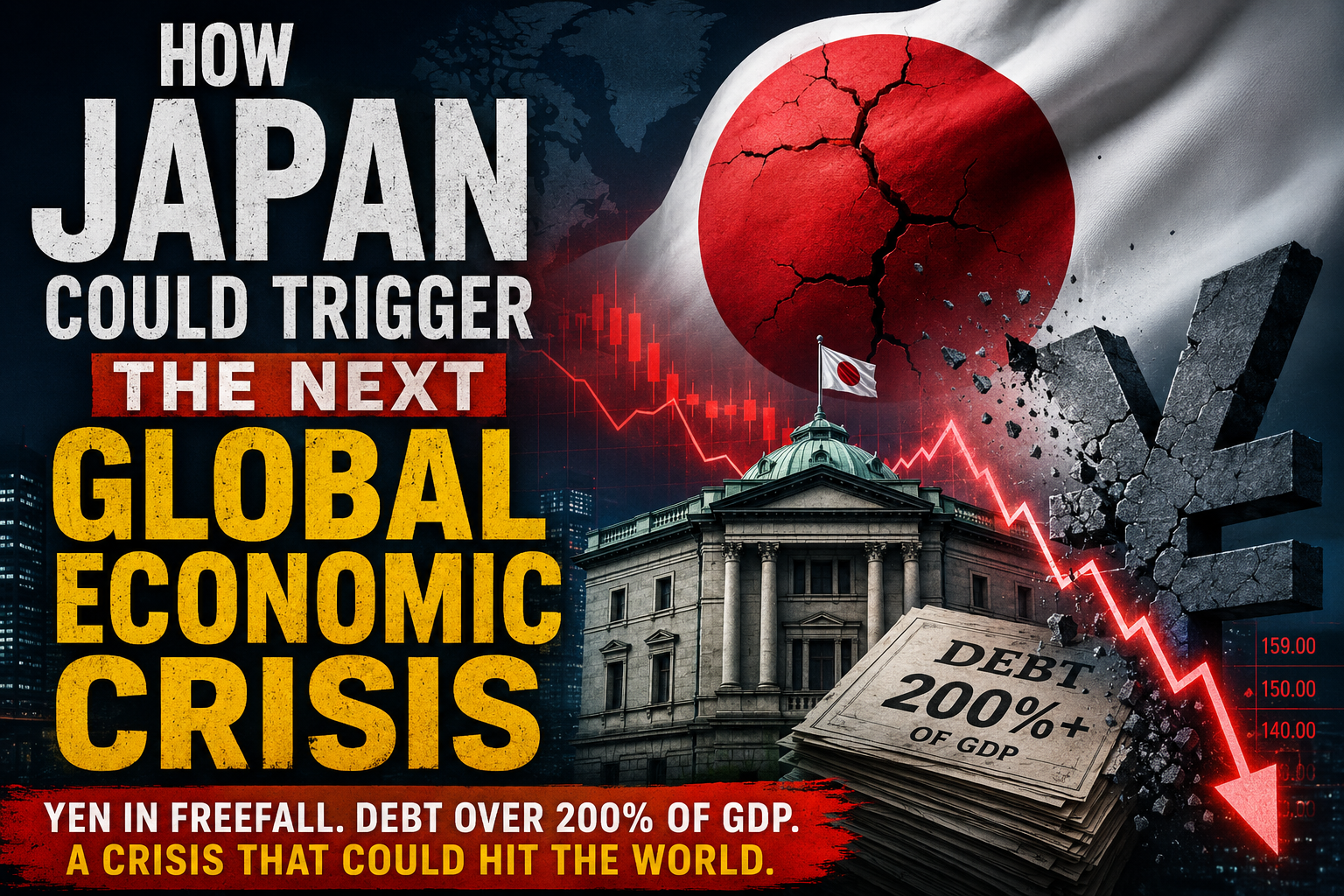
How Japan Could Trigger the Next Global Economic Crisis
In This Article
ToggleGlobal Markets · Deep Dive
How Japan Could Trigger the Next Global Economic Crisis
Japan economic crisis concerns have intensified in 2026 as the yen remains under pressure, government debt stays above 200% of GDP, and the Bank of Japan faces competing demands from inflation, currency stability and the bond market.
Japan is not necessarily heading toward an immediate financial collapse. But its position in global capital markets makes the country unusually important. Japan is a major holder of U.S. Treasury securities, the yen is a key funding currency for global investors, and Japanese banks, insurers and pension funds have substantial international investments.
The central question is therefore not simply whether Japan can manage its debt. It is whether a disorderly yen decline, bond-market stress or rapid unwinding of the yen carry trade could transmit financial stress to the rest of the world.
By the Mint & Print Markets Desk
Updated August 2026 · 14 min read
Global Contagion Risk Meter — Illustrative
Illustrative composite of yen volatility, JGB yield stress, and cross-border liquidity signals discussed in this article — not a market index.
In August 2026, the phrase "Japan economic crisis" is trending for a reason.The Japan economic crisis debate is intensifying as the yen trades near multi-decade lows, government debt remains above 200% of GDP, and the Bank of Japan faces a difficult policy dilemma.
The yen has been trading near multi-decade lows against the dollar, Tokyo and Washington have already run a record joint intervention to defend it, and Japan's public debt sits above 200% of GDP — the heaviest load of any major developed economy. None of that guarantees a global economic crisis. But it does explain why economists, traders, and financial journalists are increasingly asking the same question: could Japan, quietly, become the spark that destabilizes the rest of the world's markets?
This is not a distant, theoretical risk confined to academic papers. Japan is the world's largest single foreign holder of U.S. Treasury debt, the anchor of the multi-trillion-dollar yen carry trade, and the third-largest economy on the planet. When a country that size wobbles, the tremors travel. Below, we walk through exactly how a Japanese currency and debt crisis could transmit into a broader global financial shock — the yen, the carry trade, the Bank of Japan's policy trap, and the channels through which that stress could reach Wall Street, London, and Delhi alike.
In short: Japan's crisis risk runs through three linked pressure points — a weakening yen, a record-high government debt load, and a central bank caught between defending the currency and defending its own bond market. Any one of these breaking loose could pull the other two with it, and from there, into global markets.
01Why the Yen Is Wobbling
The immediate trigger for today's Japan economic crisis headlines is the currency itself. The yen has been sliding toward 40-year lows against the U.S. dollar, prompting Japanese and U.S. authorities to step in with a record coordinated yen-buying operation in late July 2026. That intervention bought some breathing room, but by mid-August the currency had already retraced roughly half of those gains, trading back above the ¥159-per-dollar mark, as speculators resumed betting against it once follow-up support failed to materialize.
The chart below sketches the shape of that move through 2026 — a long, grinding depreciation punctuated by sharp, short-lived rallies whenever the Bank of Japan or the Ministry of Finance intervenes.
USD/JPY — Illustrative 2026 Trajectory
Schematic, not tick-level data. Reflects the broad path: grinding depreciation toward 40-year lows, a sharp intervention-driven rally, then a partial retracement as follow-up support failed to arrive.
Directional reference: Trading Economics, FRED (Federal Reserve H.10 release), Wise historical rates.
The carry trade unwind
The deeper mechanism behind the currency's weakness is the yen carry trade. For years, near-zero Japanese interest rates made the yen the world's cheapest funding currency: global investors borrowed yen at low cost and reinvested that money into higher-yielding assets abroad — U.S. Treasuries, emerging-market bonds, tech equities, you name it. That trade only works while Japanese rates stay low and the yen stays weak. The moment the Bank of Japan signals faster or larger rate hikes, the math flips. Borrowing costs rise, the currency differential narrows, and traders holding leveraged carry positions rush to unwind them — selling foreign assets and buying back yen to close out their loans. Do that at scale, all at once, and you get exactly the kind of violent, cross-market volatility that could turn the Japan economic crisis from a domestic currency problem into a global financial shock.
Imported inflation squeezes the home front
A weak yen isn't just a headache for foreign investors — it's a domestic inflation problem inside Japan. Roughly everything the country imports, from energy to food, gets more expensive in yen terms as the currency slides. That erodes household purchasing power and pressures the Bank of Japan from the other direction: even as it worries about financial stability, it also has a growing domestic mandate to tame inflation, which argues for higher rates, not lower ones. The central bank has openly flagged this tension, noting in recent policy discussions that the pace of rate increases could need to accelerate — the opposite of what a fragile bond market wants to hear.
02Japan's Debt Mountain
Layer the debt picture on top of the currency story and the risk compounds. Japan's general government debt is estimated at well over 200% of GDP in 2026 — by some measures above 230%, and by the government's own more conservative central-and-local-government metric, still close to 188% and rising. Either way, it is the highest debt burden of any major developed economy, dwarfing the U.S., the U.K., and the rest of the G7.
Government Debt as a Share of GDP — G7 Comparison, Approx. 2026
Approximate figures blending IMF, Ministry of Finance (Japan), and OECD-style estimates for 2026; measurement methods vary by source and metric (gross vs. net debt).
Directional reference: Nippon.com / Jiji Press, BigGo Finance (MOF JGB IR materials), St. Louis Fed, Trading Economics.
What makes this dangerous is not the debt level alone — Japan has run high debt-to-GDP ratios for decades without a collapse, largely because most of that debt is held domestically and financed at ultra-low rates. What's new is the direction of travel. Decades of aggressive quantitative easing have already pushed the Bank of Japan's policy tools close to their limits, and the government itself has now made the debt-to-GDP ratio the centerpiece of its fiscal targets, projecting the burden through to 2040. The margin for error has never been thinner.
03The Policy Trap: The Bank of Japan's Impossible Choice
This is the crux of the entire story, and it's worth stating plainly: every lever available to Japanese policymakers right now makes one problem worse in order to fix another.
The Bank of Japan's Dilemma
Raising rates defends the currency but raises the cost of servicing Japan's debt and can unsettle the JGB market. Holding rates low protects debt affordability but lets the yen — and imported inflation — keep sliding.
Raise interest rates to defend the yen and slow the carry-trade unwind, and the government's own borrowing costs climb — a serious problem when your debt load already exceeds 200% of GDP. Hold rates low to keep debt servicing manageable, and the currency keeps sliding, feeding the same imported inflation that's squeezing households and, ironically, building the case for the rate hikes policymakers are trying to avoid. There is no clean exit; only a series of trade-offs, each one narrowing the space for the next.
04How a Japanese Wobble Becomes a Global Shock
This is the step that turns a domestic Japanese story into genuine global economic crisis territory: Japan's sheer size in global capital markets.
- Treasury sales. Japan is one of the largest foreign holders of U.S. government debt. If Tokyo needs to raise cash to defend the yen, fund its deficit, or meet obligations at home, selling down a portion of its foreign reserves — including U.S. Treasuries — is one of the more direct tools available.
- Spiking global yields. Large, sudden sales of Treasuries by a creditor the size of Japan would push bond prices down and yields up — and Treasury yields function as the benchmark risk-free rate for the entire global financial system. Higher yields there raise borrowing costs everywhere, from corporate debt to mortgages.
- Carry-trade liquidation. As covered above, a faster yen appreciation or higher Japanese rates forces global investors to unwind leveraged positions funded in yen, which can mean rapid, indiscriminate selling across completely unrelated asset classes simply because they were financed with the same cheap yen loans.
- Confidence contagion. Perhaps the least quantifiable but most important channel: sovereign-debt anxiety is psychologically contagious. If markets start pricing in real doubt about debt sustainability in the world's most indebted major economy, that skepticism doesn't necessarily stay contained — it tends to spread toward other heavily indebted G7 governments running large deficits of their own, from the United States to Italy to France.
Transmission Path: Tokyo to Global Markets
A simplified view of the main transmission channel discussed by market strategists: domestic stress forces asset sales, which push up global borrowing costs and can spread anxiety to other heavily indebted economies.
05Echoes of the Past: Lessons from Japan's Lost Decade
None of this is entirely new. Japan's asset-price bubble burst in the early 1990s, triggering a banking crisis and ushering in what's remembered as the "Lost Decade" — years of stagnant growth, deflation, and a savings-heavy, consumption-light economy that struggled to reflate itself even with near-zero rates. Some of the structural forces behind today's situation trace directly back to that period: a persistently high household savings rate, decades of unconventional monetary easing to fight deflation, and a debt load that kept climbing even as growth stayed muted. What's different this time is the direction — Japan spent thirty years fighting deflation and a strong currency; it's now fighting the opposite problem, inflation and a weak one, with a debt load several times larger than it carried in the 1990s.
06Could Japan Actually Trigger a Global Crisis? Weighing the Odds
It's worth being honest about the range of views here, because serious analysts don't all land in the same place.
The bear case holds that Japan is a uniquely dangerous pressure point precisely because of its scale: it's too large and too interconnected for a disorderly currency or debt event to stay contained, and the carry trade means the risk is already distributed throughout the global financial system, waiting to be triggered by a policy surprise.
The more measured case points out that Japan has carried extreme debt loads for over two decades without a crisis, in large part because roughly 90%+ of that debt is held domestically by Japanese banks, insurers, and pension funds rather than flighty foreign investors — a very different structure from, say, an emerging-market debt crisis. On this view, the current wobble is a serious, watchable risk rather than an imminent collapse, and the same joint intervention capacity Tokyo and Washington have already demonstrated this year is evidence that policymakers still have tools left to use.
The honest answer is that both camps are looking at the same data and reaching different conclusions about how much stress the system can absorb before something breaks — which is exactly why this remains one of the most closely watched macro stories of 2026, rather than a settled question.
07What Could Cushion the Blow
- Continued coordinated intervention. The joint Japan-U.S. yen-buying operation in July showed both governments are willing to act together, and further coordinated moves remain the fastest lever to slow a disorderly currency slide.
- Gradual, well-telegraphed rate hikes. A slow, clearly communicated path for Bank of Japan rate increases gives carry-trade positions time to unwind in an orderly way rather than all at once.
- Fiscal discipline signals. The government's decision to formally target its debt-to-GDP ratio as a policy centerpiece is itself a signal meant to reassure bond markets that the trajectory is being managed, not ignored.
- Japan's deep domestic investor base. Because so much JGB debt sits with Japanese institutions rather than foreign creditors, a full-scale foreign-led bond sell-off is structurally harder to trigger than in economies more reliant on external financing.
Frequently Asked Questions
Why is Japan facing an economic crisis in 2026?
The Japan economic crisis is being driven by several interconnected pressures rather than one single event. The Japanese yen has weakened significantly against the U.S. dollar, increasing the cost of imported energy, food and raw materials. At the same time, Japan continues to carry one of the world's highest government debt burdens relative to GDP, limiting the government's flexibility if borrowing costs rise sharply.
The Bank of Japan also faces a difficult policy dilemma. Raising interest rates could support the yen and help control inflation, but higher rates could increase government borrowing costs and put additional pressure on the Japanese government bond market. Keeping rates lower for longer could make debt servicing easier, but may allow the yen to remain weak and imported inflation to persist.
The situation is therefore better understood as a combination of yen weakness, high public debt, inflation and monetary-policy constraints rather than an immediate economic collapse. Japan still has a large domestic investor base and substantial financial resources, which provide important buffers against a disorderly outcome.What is happening in Japan economically right now?
The Japan economic crisis debate has intensified because several important economic indicators are moving in directions that create difficult choices for policymakers. The yen remains under pressure, inflation has become a more important concern than it was during Japan's long period of deflation, and the Bank of Japan must balance price stability against the potential consequences of higher interest rates.
The weak yen creates a particularly complicated problem. A cheaper currency can benefit Japanese exporters by making their products more competitive overseas, but it also makes imported goods and energy more expensive for Japanese households and businesses. If those higher costs feed into domestic inflation, the Bank of Japan may face stronger pressure to tighten monetary policy.
Meanwhile, Japan's large government debt means that interest-rate increases cannot be considered in isolation. Even gradual increases in borrowing costs can eventually affect government finances and the bond market. This combination of currency pressure, inflation and debt explains why the Japan economy 2026 outlook is being watched closely by investors around the world.
How could Japan's problems trigger a global economic crisis?
The Japan economic crisis could affect the rest of the world through several financial transmission channels. One of the most important is the yen carry trade, in which investors borrow yen at relatively low interest rates and invest in higher-yielding assets in other countries. If Japanese rates rise or the yen appreciates rapidly, investors may rush to unwind these positions.
A large-scale carry-trade unwind could result in investors selling equities, bonds and other assets internationally to repay yen-denominated borrowing. This could create volatility even in markets that have little direct economic exposure to Japan.
Another potential channel is the international bond market. Japan is a major participant in global capital markets, and Japanese institutions hold substantial overseas investments. If financial stress encouraged Japanese investors to repatriate capital or reduce foreign holdings, markets such as U.S. Treasuries could experience additional selling pressure. Higher global bond yields could then increase borrowing costs for governments, companies and households.
The biggest concern is therefore not simply whether Japan experiences a recession. It is whether a yen crisis, bond-market stress and carry-trade liquidation occur at the same time and create a broader global economic crisis.How could Japan fix its economy?
There is no single solution to the Japan economic crisis, because the country's major problems are closely connected. Policymakers need to stabilize the yen and control inflation while also preventing a sharp increase in government borrowing costs. Achieving all three objectives simultaneously is one of the biggest challenges facing Japan.
A gradual and well-communicated path toward higher interest rates could help normalize monetary policy without triggering an abrupt carry-trade unwind. Currency intervention could also be used to reduce disorderly movements in the yen when market conditions become exceptionally volatile.
Fiscal policy is equally important. Credible medium-term plans to stabilize the government debt-to-GDP ratio could reassure bond investors and reduce concerns about long-term debt sustainability. At the same time, structural reforms that improve productivity, labor-force participation and economic growth could make Japan's debt burden easier to manage over time.
Japan also has an important advantage: its financial system has historically relied heavily on domestic investors. That provides a degree of protection against the type of sudden foreign-capital flight seen in some emerging-market debt crises.Ultimately, managing the Japan debt crisis will require monetary discipline, credible fiscal policy and sustainable economic growth rather than relying on any single emergency measure. The objective should be to prevent today's currency and debt pressures from developing into a much larger financial shock for Japan and the global economy.
The Bottom Line
The Japan economic crisis is not simply a story about a falling yen or a government debt ratio above 200% of GDP. It is a test of whether the world's third-largest economy can manage currency weakness, inflation, high public debt and rising interest rates at the same time. The bigger question is whether these pressures remain contained within Japan or become the starting point for a broader global economic crisis.
Could the Japan economic crisis force the Bank of Japan to raise interest rates faster than financial markets expect? Could higher Japanese rates trigger a disorderly unwinding of the global yen carry trade? And if investors begin moving money out of Japanese bonds or repatriating capital from overseas markets, could that push global bond yields higher and create financial stress in the United States, Europe and emerging markets?The Japan debt crisis is particularly important because the country's enormous debt burden limits the room available for policymakers. If interest rates remain low, the yen could remain under pressure and imported inflation could continue hurting Japanese households. If rates rise sharply, however, government borrowing costs could increase and pressure could build in the Japanese government bond market. This is the difficult policy balance at the heart of the Japan economic crisis.
There is also a much bigger global question: What happens if Japan's financial stress reaches international markets? Japan is deeply connected to global capital flows, U.S. Treasury markets and the international investment system. A major yen crisis could encourage investors to unwind leveraged positions funded in yen, potentially forcing them to sell assets elsewhere. Could that create a chain reaction across currencies, equities and bonds? Could higher global yields make borrowing more expensive for businesses and governments already carrying large amounts of debt?
At the same time, it would be wrong to assume that the Japan economic crisis automatically means Japan is heading toward an imminent collapse. Japan has a large domestic investor base, substantial financial assets and considerable experience managing high levels of government debt. Policymakers also retain tools including monetary policy, currency intervention and fiscal measures. These factors could help prevent a disorderly outcome.
The real concern is therefore not whether Japan economic crisis conditions exist, but whether several pressures intensify simultaneously. What if the yen continues falling while inflation remains elevated? What if the Bank of Japan has to tighten policy while government debt-servicing costs rise? What if the yen carry trade unwinds at the same time that global investors become nervous about sovereign debt?
These are the scenarios that could turn a contained Japan economic crisis into a genuine global economic crisis. For anyone following the Japan economy 2026 outlook, the most important signals to watch are the yen, Japanese government bond yields, Bank of Japan policy, inflation, government debt and international capital flows.
Ultimately, Japan economic crisis risk should be viewed as a warning signal rather than a prediction of an inevitable global crash. Japan does not have to collapse for global markets to feel the consequences. A disorderly currency move, a rapid carry-trade unwind or significant bond-market stress could be enough to transmit volatility across the world's financial system. The central question for the rest of 2026 is therefore simple: Can Japan stabilize the yen, control inflation and manage its enormous debt burden without triggering the next global financial shock?
Further Reading & Sources
For readers who want to go deeper, these are among the most useful primary and journalistic sources on this topic:
- Forbes — coverage of the yen's slide and its global financial-crisis risk
- Asia Times — analysis of how a yen rout could spark a U.S. financial crisis
- Peterson Institute for International Economics — research on the global economic effects of Japanese financial stress
- Investopedia — background on Japan's Lost Decade and its causes
- Asian Development Bank — working paper on why Japan was hit hard by the global financial crisis
- Stanford Shorenstein Asia-Pacific Research Center — causes of Japan's economic stagnation
- Nippon.com / Jiji Press — reporting on Japan's official debt-to-GDP projections
- FRED (Federal Reserve Bank of St. Louis) — Japanese yen to U.S. dollar exchange rate data
Internal Links for more such Articles –












Post Comment