LATEST BLOGS

Learn Stock Market in India (2026): The Secret Most Beginners Never Figure Out

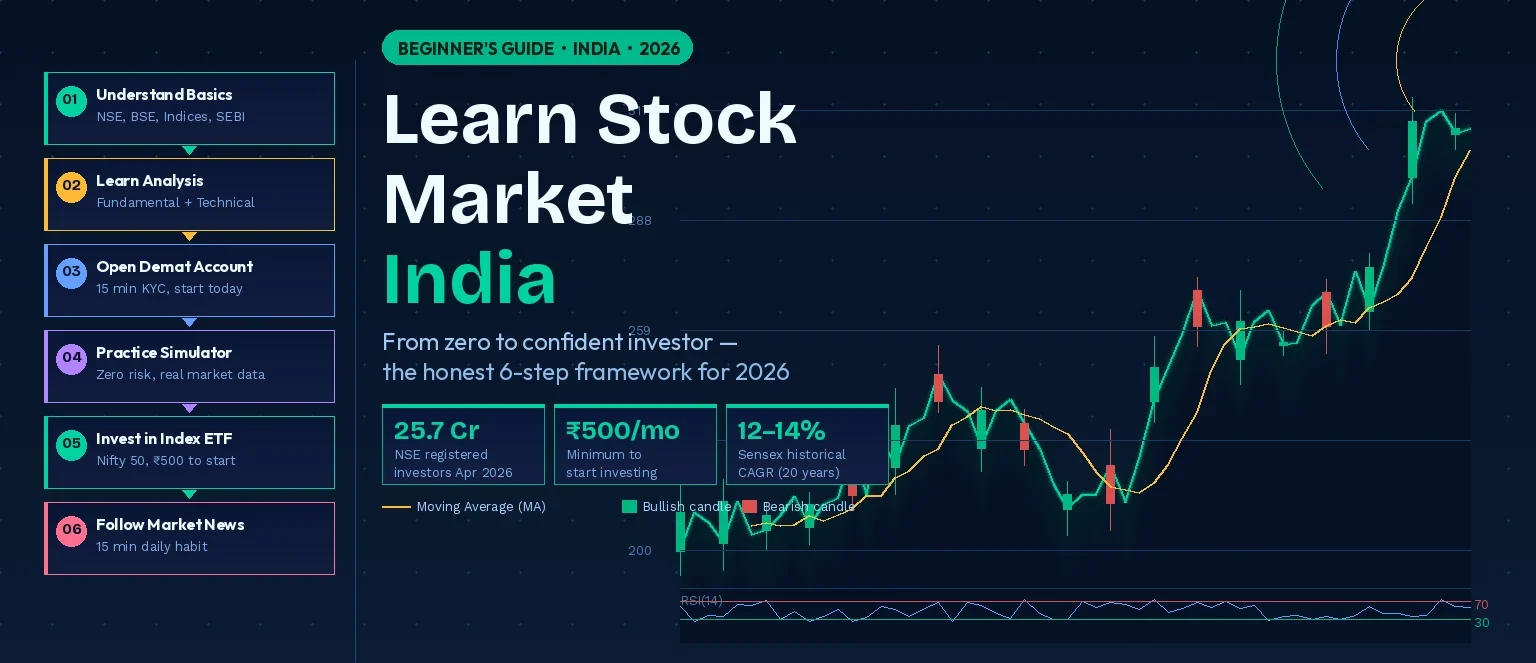
Learn stock market India 2026 — 6-step beginner's guide with candlestick chart, RSI indicator, and Nifty 50 investment framework | Mint & Print

Quick Answer

If you want to learn stock market in India successfully, focus on building strong fundamentals, understanding risk management, and following a long-term learning roadmap. With the right approach, beginners can gradually develop investing confidence and practical market knowledge .

To learn stock market in India, start with the basics — understand how NSE and BSE work, what shares and indices are, and how prices move. To learn Stock Market the learning begins with the study fundamental and technical analysis using free platforms like Zerodha Varsity. Open a Demat account with a discount broker, practice on a virtual simulator, start with a small SIP or index ETF, and follow market news daily. The entire process can begin today with zero capital using free resources.

How to Learn Stock Market in India - Introduction

Here is a number that should stop you mid-scroll: as of April 2026, the NSE has 25.7 crore registered client codes — and it now takes just 6 to 8 months to add 1 crore new investors.

India is building a nation of investors at breakneck speed. And yet, SEBI surveys show that 63% of Indian households are aware of stock investing, but only 9.5% actively participate.

The gap is not money. It is not access. It is knowledge.

Most beginners either drown in jargon-heavy content or fall for YouTube traders promising “₹1,000 daily from ₹10,000 capital.” This guide does neither. Written by a NISM-certified educator, it gives you a clean, step-by-step framework to genuinely learn the stock market — from absolute zero to your first confident investment.

What Is the Stock Market? (The 60-Second Read for Learn Stock Market)

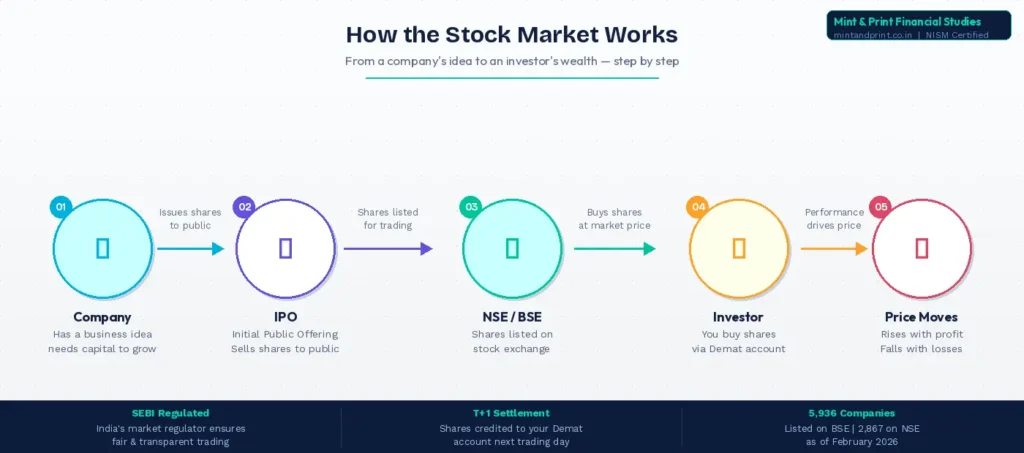
How the stock market works in India — infographic showing company IPO to shares listed on NSE BSE to investor buying shares and price movement | Mint & Print
How the Indian stock market works: A company raises capital via IPO → shares list on NSE/BSE → investors buy via Demat account → price moves with company performance. Regulated by SEBI. | Mint & Print Financial Studies

The stock market is a regulated marketplace where publicly listed companies sell ownership stakes — called shares — to investors, and investors trade those shares among themselves.

In India, this happens across two primary exchanges:

  • BSE (Bombay Stock Exchange) — established 1875, Asia’s oldest exchange, 5,936 companies listed as of February 2026 with a total market capitalisation of ₹46,537,224 crore.
  • NSE (National Stock Exchange) — established 1992, technology-first exchange, home to the Nifty 50 index and the majority of retail trading volume in India.

When you buy a share of Reliance Industries on NSE, you own a tiny fraction of Reliance. If Reliance grows, your share price rises. If it earns profits, you may receive dividends. That is the fundamental logic — you become a part-owner of a business.

The 6-Step Framework to Learn the Stock Market in India

Step 1: Understand the Basics of Stock Market   (Week 1)
Step 2: Learn the Two Types of Analysis (Weeks 2–4)
Step 3: Open a Demat Account (Day 1 — Takes 15 Minutes)
Step 4: Practice on a Simulator Before Using Real Money
Step 5:  Start  Small  With  an  Index  ETF  or SIP
Step 6: Follow Market News Daily (15 Minutes a Day)

Step 1: Understand the Basics (Week 1)

Before touching a single rupee, spend one week understanding the foundational concepts:

  • Primary vs Secondary market — companies raise fresh capital in the primary market (IPOs); investors trade among themselves in the secondary market
  • Indices — Nifty 50 tracks India’s top 50 companies; Sensex tracks the top 30 on BSE. These are the “temperature” of the market
  • Market participants — retail investors, FIIs (Foreign Institutional Investors), DIIs (Domestic Institutional Investors), and market makers
  • SEBI — India’s market regulator, the referee that keeps the game fair

Free resource: Zerodha Varsity offers in-depth lessons from beginner to advanced — no ads, no sign-ups, completely free. Start with Module 1: Introduction to Stock Markets.


Step 2: Learn the Two Types of Analysis (Weeks 2–4)

Every investment decision in the stock market is based on one or both of these:

Fundamental Analysis — studying a company’s financial health to determine if its stock is worth buying. You evaluate revenue growth, profit margins, PE ratio, debt levels, management quality, and future prospects. Think of it as reading a company’s report card.

Technical Analysis — studying price charts and historical trading patterns to predict future price movements. You use tools like candlestick patterns, moving averages, RSI, MACD, and support/resistance levels to identify entry and exit points.

Must Read Learn  “Fundamental Analysis vs Technical Analysis” — investor type, time horizon, tools used, best for Investing & Trading

Which should beginners learn first? For long-term investors — fundamental analysis. For those interested in trading — technical analysis. Most seasoned investors use both.

Mint & Print’s Study Material and Research Lab sections cover both in plain, structured language built specifically for Indian market learners.


Step 3: Open a Demat Account (Day 1 — Takes 15 Minutes)

It is mandatory to have a Demat account to buy or sell shares on NSE or BSE. It is linked to a trading account (for executing orders) and a bank account (for fund transfers). KYC is now 100% digital and takes 15–30 minutes.

You need: PAN card, Aadhaar, and bank account details.

For beginners, discount brokers like Zerodha or Groww are the right choice — they charge zero commission for holding stocks long-term and have clean, easy-to-use apps.

Do not overthink this step. Open the account, verify your KYC, and let it sit while you continue learning. Having an account with real market access makes learning dramatically more effective.


Step 4: Practice on a Simulator Before Using Real Money

Virtual trading platforms let you buy and sell shares using fake money in real market conditions. This is the closest thing to a driving test before hitting the highway.

Practice for at least 2–4 weeks. Track your decisions, note why you bought or sold, and measure your accuracy. You will make mistakes — and it is infinitely better to make them with fake money first.


Step 5: Start Small With an Index ETF or SIP

Many mutual funds and ETFs allow you to start a SIP with as little as ₹100 or ₹500 a month. The goal is to build the habit of investing first; the amount can always increase as your income grows.

For a first investment, a Nifty 50 ETF is ideal. It automatically spreads your money across India’s top 50 companies — Reliance, TCS, HDFC Bank, Infosys, ITC, and 45 more. The Sensex has historically delivered approximately 12% CAGR returns over 20-year periods. You don’t need to pick stocks — the index does the work.


Step 6: Follow Market News Daily (15 Minutes a Day)

Markets respond to news in real time. Develop a daily habit of reading:

  • Economic Times or Mint (Indian financial news)
  • NSE/BSE announcements for stocks you hold
  • RBI, SEBI policy updates
  • Global cues: US Federal Reserve decisions, crude oil prices, FII flow data

Over time, you will start connecting events to market movements. That is when learning becomes intuition.


5 Mistakes Beginners Make to Learn the Stock Market

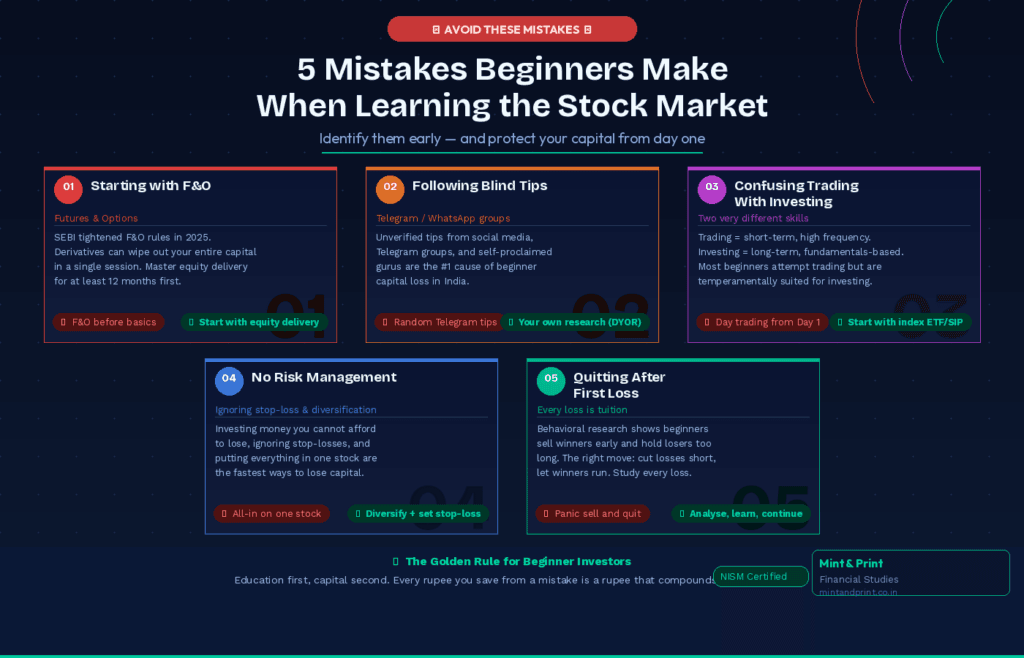
5 mistakes beginners make when learning the stock market in India — F&O trading, blind tips, no risk management, trading vs investing confusion, quitting after first loss | Mint & Print
Avoid these 5 common beginner mistakes in the Indian stock market — from F&O overconfidence to following Telegram tips. Learn the right approach with Mint & Print. | NISM Certified

Mistake 1: Starting with F&O (Futures & Options)

SEBI tightened F&O eligibility criteria in 2025. Beginners are advised to trade only in equity delivery — not derivatives — for the first 12 months until fundamentals are mastered. F&O can wipe out capital faster than any other segment. Earn your basics first.

Mistake 2: Following Unverified Tips

If someone in a Telegram group is giving you “sure-shot” stock tips, run in the opposite direction. SEBI mandates that investment advice must come from registered advisors only. Always verify the source.

Mistake 3: Confusing Trading With Investing

Trading (buying and selling frequently for short-term gains) and investing (holding quality stocks for years) are two completely different skills. Most beginners attempt trading but are temperamentally suited for investing. Know which path fits you.

Mistake 4: No Risk Management

Never invest money you cannot afford to lose. Set stop-losses on every trade. Diversify across sectors. A single bad stock should never destroy your portfolio — that is what position sizing prevents.

Mistake 5: Stopping Learning After the First Loss

Behavioral finance research shows investors tend to sell winning stocks prematurely while holding losing stocks indefinitely hoping for recovery. The opposite is correct: cut losses short, let winners run. Every loss is tuition — but only if you study it.


Key Takeaways

  • India has 25.7 crore NSE-registered investors in 2026 — but only 9.5% of households actively participate. The opportunity is massive
  • Learn in this order: basics → analysis → open Demat → simulator → small investment → daily news habit
  • Use Zerodha Varsity and Mint & Print Study Material for free, structured Indian market education
  • Start with a Nifty 50 ETF or SIP — not stocks, not F&O
  • Avoid tips, avoid leverage, avoid panic selling — discipline is the real edge
People Also Ask

Frequently Asked Questions

6 Questions Answered
These are the most searched questions about learning the stock market in India — answered by Amit K Sharma, NISM-Certified Financial Educator at Mint & Print.
Learning the stock market is a journey, not a destination — but here is a realistic timeline:
2–4 Weeks Basic concepts — what stocks are, how NSE/BSE work, what indices mean
6–12 Months Competent investor — real market participation, reading financials
2–3 Years Professional-level — advanced analysis, options, portfolio strategy

There is no shortcut — but the learning curve is exciting, not painful, if you follow a structured path. Start with Mint & Print's Study Material and build one concept at a time.
Two resources stand out for Indian learners:
Zerodha Varsity — the most comprehensive free platform covering everything from market basics to options theory. No ads, no sign-ups required.

Mint & Print Study Material — specifically designed for Indian investors at every level. Plain-language explanations, real NSE/BSE examples, and NISM-curriculum aligned content.

Use both in parallel — Zerodha Varsity for depth, Mint & Print for India-specific context and current market analysis.
Absolutely — and this is the right way to start.
✅  Open a free Demat account — most brokers (Zerodha, Groww) have zero account opening fees
✅  Use virtual trading simulators to buy and sell with fake money in real market conditions
✅  Study free resources on Zerodha Varsity and Mint & Print for 2–3 months
✅  Follow market news daily — 15 minutes builds deep market intuition over time

Knowledge first, capital second. Every rupee you protect through education is a rupee that compounds in your favour later.
There is no SEBI-mandated minimum for equity delivery investing. Here is what the practical starting points look like:
₹100–₹500/month SIP in a mutual fund or Nifty 50 ETF — the ideal beginner starting point
₹10+ Direct stock purchase — price of one share (some penny stocks start here)
₹30,000+ Single share of premium stocks like MRF — no minimum lots required

Recommendation: Start with a ₹500/month Nifty 50 ETF SIP. It instantly diversifies your money across India's top 50 companies and builds the investing habit with minimal risk.
The system is safe. Uninformed decisions are not.
The Indian stock market is regulated by SEBI (Securities and Exchange Board of India) — one of Asia's most rigorous market regulators. Investor protections include:

✅  Mandatory disclosures by all listed companies
✅  SEBI SCORES — official investor grievance portal
✅  T+1 settlement — shares credited next trading day
✅  Circuit breakers on NSE/BSE to prevent panic crashes

Beginners who invest in quality diversified assets (Nifty 50 index funds, blue-chip stocks) with a long-term horizon of 5+ years have historically seen strong, positive returns from Indian markets.
Both are India's primary stock exchanges — here is the quick comparison:
NSE Founded 1992  |  2,867 listed companies  |  Home of Nifty 50  |  Highest retail trading volume

BSE Founded 1875  |  5,936 listed companies  |  Home of Sensex  |  Asia's oldest exchange

For beginners, the difference is minimal. Most large companies are listed on both. Your Demat account works on both NSE and BSE automatically — you simply choose which exchange to place your order on when buying.

Conclusion

The stock market is not a casino. It is not a get-rich-quick machine. And it is definitely not reserved for people with finance degrees or large capital.

It is a system — and like any system, it rewards those who take the time to understand it.

India is adding new investors at the fastest pace in its history. The tools are free. The platforms are simple. The regulatory framework is strong. The only remaining barrier is the decision to start learning.Today’s best first step: open Zerodha Varsity on one tab and Mint & Print’s Study Material on another. Read for 30 minutes. Tomorrow, open a Demat account. Next week, buy your first Nifty ETF unit.

Wealth is not built in a day. But it starts with exactly this moment.

In the end, the best way to learn stock market investing is to start small, stay consistent, and focus on building knowledge step by step. Many beginners try to learn stock market strategies overnight, but real success comes from understanding the basics, practicing regularly, and avoiding emotional decisions. If your goal is to learn stock market in India and become a confident long-term investor, begin with simple concepts like Demat accounts, SIPs, mutual funds, and fundamental analysis. The more you learn stock market trends, risk management, and investing psychology, the better your financial decisions will become over time. Remember, every successful investor once started as a beginner — and your journey to learn stock market investing can begin today with patience, discipline, and continuous learning.

This article is for educational purposes only and does not constitute investment advice. Stock market investments are subject to market risks. Mint & Print is a NISM-certified financial education platform. We are not SEBI registered investment advisors. Please read all scheme-related documents carefully before investing.

Author: Founder Desk — Amit K Sharma | NISM Certified

Share this content:

Post Comment