








Every Investor’s Burning Questions Answered: The Ultimate 2026 Investor Guide
In This Article
ToggleInvestor's Burning Question
SIP, mutual funds, gold import duty, Zerodha, stock market basics — every question every Indian investor is asking this year, finally answered clearly.
📅 May 2026
📖 12 min read
🇮🇳 India-focused
✅ Authority data cited
10
Questions answered
₹500
Min SIP to start
90%
F&O traders lose money*
You searched. You landed here. That means you are sitting somewhere between "I want to start investing" and "I have no idea where to begin." You are not alone — and this guide fixes that.
Every month, millions of Indians type the exact questions this guide answers — about SIPs, gold prices, stock markets, demat accounts, and how to not let your entire salary vanish before the 25th. No jargon. No lectures. Just the clearest answers, backed by data from SEBI, RBI, NSE, and global financial authorities.
5.2 Cr+
Active SIP accounts in India (AMFI, 2026)
₹26,688 Cr
Monthly SIP inflows (AMFI Jan 2025)
9.3 Cr
Registered demat accounts (SEBI, 2025)
01 · Personal Finance
How to Save Money from Salary in India (2026)
Q: What are the best ways to save money in India from salary 2026?
The question most Indians are too embarrassed to ask — and too broke to ignore. The answer that actually works: pay yourself first, spend what's left. Not the other way around.
The 50-30-20 Rule for Indian Salaries
Recommended budget allocation on ₹30,000/month take-home · Source: RBI Financial Literacy initiative
Needs 50% (₹15,000)
Wants 30% (₹9,000)
Savings 20% (₹6,000)
Source: RBI Financial Literacy Centre, NCFE National Survey 2023
🧾
Cancel forgotten subscriptions
Check UPI autopay right now. Average Indian has 3–4 active subscriptions they forgot about, costing ₹800–₹2,000/month.
Save ₹800–2,000/mo
🍳
Cook one extra meal/day
Replacing one Swiggy/Zomato order per day with home cooking saves ₹2,000–₹4,000 per month — that is a full SIP instalment.
Save ₹2,000–4,000/mo
⏱️
The 24-hour rule
Wait 24 hours before any non-essential purchase above ₹500. 80% of the time, you won't buy it. This is the simplest anti-impulse tool.
Behavioural finance
The real reason most people can't save: Lifestyle inflation. Every raise gets absorbed by a bigger phone, a newer bike, or more Swiggy orders. Fix the percentage you save — not the rupee amount — and savings auto-grow with income.
02 · Mutual Funds
How to Start SIP in Mutual Funds (Step-by-Step 2026)
Q: How to start SIP in India step by step for beginners 2026?
A Systematic Investment Plan (SIP) is the simplest way to build wealth in India. You invest a fixed amount every month into a mutual fund — automatically. The compounding does the heavy lifting.
⚡ SIP Wealth Calculator
Monthly SIP Amount
₹5,000
Investment Duration
20 years
Expected Return (p.a.)
12%
Total Amount Invested
₹12,00,000
₹49.9 L
Estimated corpus · Wealth gain: ₹37.9 L
-
1Open an investment account (free)Use Groww, Zerodha Coin, or Paytm Money. Takes 10 minutes, fully online.
-
2Complete KYCPAN card + Aadhaar + selfie. Done in 2 minutes. Mandatory since SEBI 2023 guidelines.
-
3Choose your fund typeBeginners → Index fund (Nifty 50). Moderate → Large-cap. Aggressive → Mid/small-cap.
-
4Set your SIP date 2–3 days after salary creditThis automates discipline. You never miss an instalment or "forget" to invest.
-
5Leave it alone and increase by 10% annuallySIP works through rupee cost averaging + compounding. Stopping during a crash eliminates the entire benefit.
₹5,000/month SIP — Power of Compounding Over 20 Years
At 12% p.a. · Invested vs Corpus growth · Source: AMFI SIP calculator methodology
Source: AMFI India · Based on historical Nifty 50 CAGR 1990–2024
AMFI data (2025): India crossed 5.2 crore SIP accounts. Average SIP size: ₹2,263/month. Monthly SIP inflows hit ₹26,688 crore in Jan 2025 — an all-time high. Source: Association of Mutual Funds in India (AMFI)
03 · Fund Selection
How to Choose the Right Mutual Fund
Q: Which mutual fund is best to invest in India 2026?
There is no single "best" fund. There is only the best fund for your goal, timeline, and risk tolerance. Here is the framework every smart investor uses.
| Your Profile | Fund Type | Avg. 5-yr Return | Risk |
|---|---|---|---|
| Complete beginner | Index Fund (Nifty 50) | ~14% p.a. | Low |
| 5+ yr horizon | Large-cap equity | ~13–16% p.a. | Moderate |
| Aggressive growth | Mid/small-cap | ~18–24% p.a. | High |
| Capital safety | Debt / Liquid fund | ~6–8% p.a. | Very Low |
| Balanced approach | Hybrid / Flexi-cap | ~13–17% p.a. | Moderate |
Nifty 50 Index — Calendar Year Returns
Annual % return 2015–2024 · Source: NSE India official data
Source: NSE India (nseindia.com) · Past performance does not guarantee future returns
What to check before buying any fund: Expense ratio under 0.5% for index funds (under 1.5% for active). Exit load rules (usually 1% if redeemed within 1 year). Fund manager track record of at least 5 years beating the benchmark. AUM above ₹500 crore.
- ✗Any fund "guaranteeing returns" — mutual funds legally cannot guarantee returns
- ✗Funds with expense ratio above 2% — you are paying too much in fees
- ✗NFOs from unknown AMCs — no track record to evaluate
- ✓Index funds from established AMCs (SBI, HDFC, Nippon, Mirae) with low expense ratios
- ✓Diversified flexi-cap funds for first-time active fund investors
04 · Getting Started
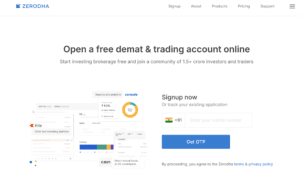
How to Open a Demat Account in Zerodha (2026)
Q: How to open demat account in Zerodha step by step 2026?
Zerodha is India's largest retail stockbroker by active clients, with over 75 lakh registered users as of 2025. Opening an account is fully online, takes under 15 minutes, and is completely free of hidden charges.
Account Opening
₹200
One-time fee
Annual Maintenance
₹300
Per year
Equity Delivery
₹0
Completely free
Intraday / F&O
₹20
Per order or 0.03%
- 1Go to zerodha.com → Sign upEnter your mobile number and verify OTP.
- 2Fill in personal detailsName, email, date of birth — must match your PAN card exactly.
- 3Upload PAN card + Aadhaar e-KYCAadhaar must be linked to your mobile for OTP verification. This is mandatory per SEBI.
- 4Upload bank proofCancelled cheque or bank statement (last 3 months).
- 5Complete IPV (30-second webcam selfie)In-Person Verification — mandatory per SEBI regulations for all demat accounts.
- 6E-sign and wait 24–48 hoursAccount is activated. You'll receive login credentials via email and SMS.
⚠️ Most common rejection reason: Name mismatch between PAN and Aadhaar. Check both documents before uploading. Even a single character difference causes the application to fail.
05 · Commodities
Gold Import Duty India 2026 — What Every Investor Must Know
Q: Why is gold import duty India trending 2026? What is the impact on gold prices?
India hiked gold import duty in May 2026, triggering a 26,000+ monthly search spike. Here is what actually happened and what it means for your gold holdings.
India Domestic Gold Price vs Import Duty Changes
Indexed price movement (100 = Jan 2022) · Source: MCX India, India Bullion & Jewellers Association (IBJA)
Source: MCX India · IBJA · Ministry of Finance duty notifications
| Your Situation | Recommended Action | Reason |
|---|---|---|
| Hold gold ETF already | Hold | Higher domestic price supports ETF NAV short-term |
| Planning to buy jewellery | Consider waiting | Prices elevated; duty changes can reverse |
| Long-term gold allocation | SGBs best option | 2.5% interest + price appreciation; no making charges |
| Speculative play on duty | Avoid | Import duty is policy-driven and can reverse without warning |
"India's gold import duty adjustments directly impact the domestic gold price premium over international prices. In 2023, India held the largest gold import duty globally at 15%, creating a significant price wedge compared to neighbouring markets."
WGC
World Gold Council · Gold Demand Trends Report 2024 · gold.org
06 · Regulation
SEBI F&O Margin Rules 2025–26 — What Traders Must Know
Q: What are the new SEBI margin rules for F&O trading?
SEBI tightened F&O margin rules significantly to reduce retail trader losses. A landmark SEBI study found that over 90% of individual F&O traders lose money — the rules aim to reduce over-leverage.
F&O Trader Profitability — SEBI Study Data
% of individual traders who incurred net losses in F&O · Source: SEBI Study 2023 (3-year data, FY21–23)
Source: SEBI "Study on Profit and Loss of Individual Traders" Oct 2023 · sebi.gov.in
| What Changed | Before | After (2025–26) |
|---|---|---|
| Upfront margin | Broker could fund client | Full SPAN + Exposure collected upfront |
| Peak margin reporting | End-of-day position | Highest intraday exposure |
| Intraday leverage | Up to 5–10x common | 1x–5x depending on product |
| Min. contract size (index) | ₹5 lakh notional | ₹15 lakh notional (phased) |
Key takeaway: SEBI's goal is to stop retail traders from blowing up accounts on over-leveraged positions. If you are new to markets, start with equity delivery trading. F&O is for experienced market participants with dedicated, ring-fenced risk capital — not your savings.
07 · Market Psychology
Can Stock Markets Rise During War? The Data Answers
Q: How does war affect the stock market? Do stocks go up or down during war?
This question spiked after the US-Israel-Iran tensions of 2025–2026. The surprising answer, backed by 80 years of market history: markets often rise during wars, not fall.
S&P 500 / Major Index Returns — 6 Months After Conflict Start
Historical geopolitical events vs. market performance · Source: JP Morgan Asset Management, Bloomberg
Source: JP Morgan Guide to the Markets Q1 2025 · Bloomberg historical data
Gulf War · Aug 1990
Initial shock: S&P 500 fell 15%. Recovery within 3 months. 6-month return: +30%.
+30% → 6-month gain
Iraq War · Mar 2003
Markets rallied on day of invasion. S&P 500: +25% over 6 months post-start.
+25% → 6-month gain
Russia-Ukraine · Feb 2022
Nifty 50 fell ~15% in weeks, fully recovered within 3 months. Energy stocks surged.
Recovered in 3 months
Israel-Hamas · Oct 2023
Markets fell 3–4% in the first week, fully recovered within 3–4 weeks.
-4% initial · Recovered in 4 weeks
For Indian investors specifically: India is insulated unless oil prices spike sharply — India imports 85% of its oil. Watch crude prices, not battlefield maps.
08 · Education
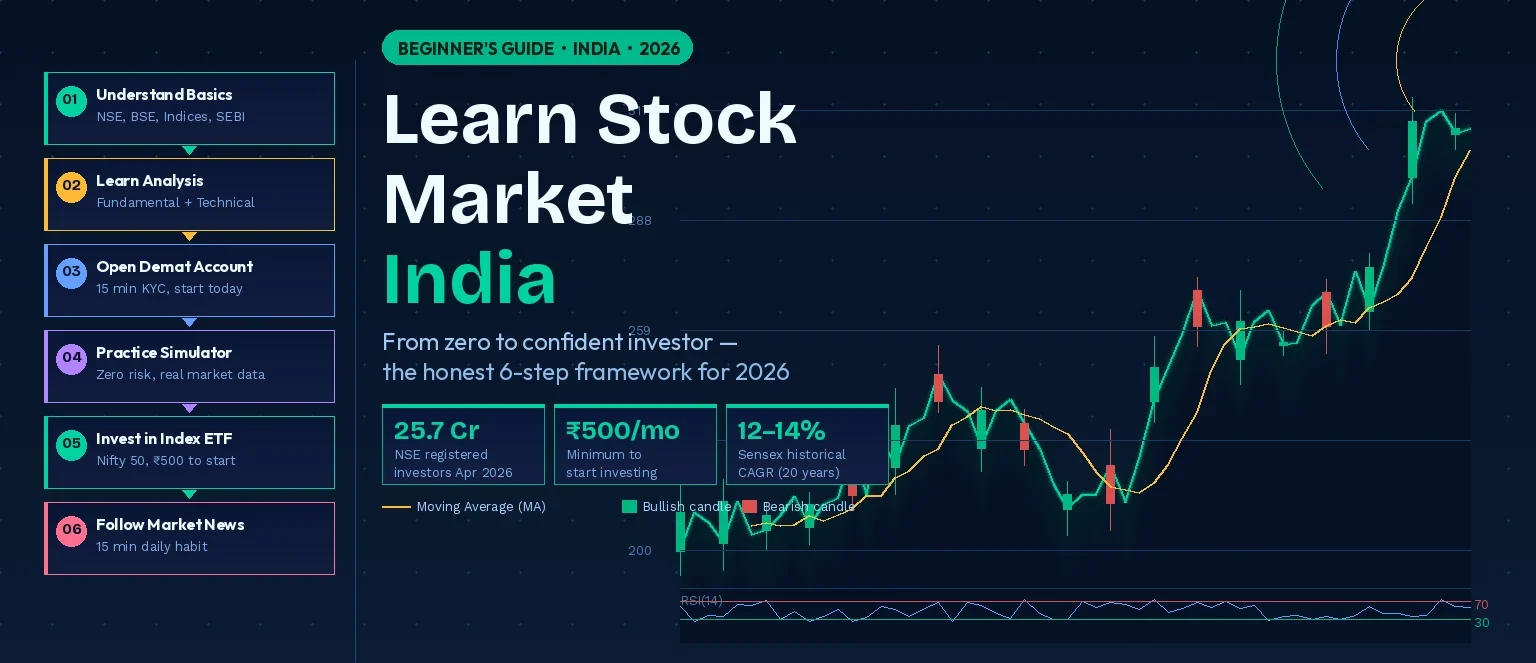
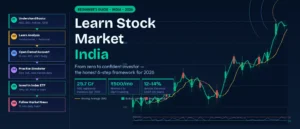
Learn Stock Market Basics for Beginners India 2026
Q: Best free resources to learn stock market for beginners India 2026?
You do not need a finance degree. You need 30 minutes a day, the right roadmap, and the discipline to not start with F&O.
| Timeframe | What to Learn | Resource |
|---|---|---|
| Week 1–2 | What is a stock, index (Nifty/Sensex), demat account, equity vs debt | Zerodha Varsity (free) |
| Week 3–4 | P/E ratio, reading a balance sheet, RSI indicator basics | NSE NCFM modules (free) |
| Month 2 | Paper trading, following 2–3 consumer companies, reading quarterly results | Screener.in (free) |
| Month 3+ | Portfolio construction, SIP + direct equity combination, tax implications | SEBI Investor Education portal |
⚠️ The #1 beginner mistake: Starting with intraday trading or F&O before understanding fundamentals. SEBI data (2023 study): 90%+ of individual F&O traders lose money over a 3-year period. Start with long-term equity investing — always.
09 · Valuation
P/E Ratio — The One Number Every Smart Investor Uses
Q: What is P/E ratio and how do smart investors use it?
The Price-to-Earnings (P/E) ratio tells you how much the market is willing to pay for ₹1 of a company's earnings. It is the single most widely used valuation metric globally.
Nifty 50 Historical P/E Ratio — Buy Zones vs Expensive Zones
Monthly data 2014–2024 · Source: NSE India, Motilal Oswal Research
Source: NSE India official P/E data · Motilal Oswal 30th Annual Wealth Creation Study 2024
| P/E Range | Signal | Historical context (Nifty) |
|---|---|---|
| Under 14x | Strong buy zone | Rare — seen in 2008 crash, Covid Mar 2020 |
| 14x–20x | Fair value range | Typical range for Indian large-caps historically |
| 20x–28x | Premium growth valuation | Justified for compounders; cautious for indices |
| Above 28x | Historically expensive | Seen in 2021 bull market; corrections followed |
Important caveat: P/E is one number. Never buy or sell based on P/E alone. A low P/E can be a "value trap" if the business is genuinely declining. A high P/E can be justified for quality compounders over decades (HDFC Bank averaged P/E 25–35x for 20 years and still delivered 20%+ CAGR).
10 · Smart Spending
Pay Now vs Pay Later — Which Is Actually Smarter?
Q: Is Buy Now Pay Later (BNPL) good or bad? Pay now vs pay later — which one wins?
BNPL services have exploded in India with players like LazyPay, ZestMoney, and Simpl. Here is the honest, data-backed breakdown.
BNPL vs Credit Card vs Cash — True Cost on ₹10,000 Purchase
6-month scenario with missed payment · Source: RBI Consumer Finance Data, CIBIL
Source: RBI "Report on Trends and Progress of Banking in India 2023–24" · CIBIL consumer credit report 2024
✅
Pay Now (Cash)
Zero interest. Full peace of mind. Builds saving discipline. Forces you to buy only what you can afford. Best for everything.
Always best default
⚖️
0% EMI (genuine offer)
Works well for large purchases (appliances, electronics) where you have the money but keep it invested. Net cost = ₹0 in interest.
Use strategically
⚠️
BNPL / Paid EMI
Hidden fees + 18–36% annualised interest. Impacts CIBIL score if missed. Makes you feel richer than you are.
Avoid for non-essentials
If you cannot afford it now, BNPL does not make you able to afford it — it makes it worse, with interest.
FAQ
Questions Every Investor Keeps Asking
The most searched follow-up questions — answered in 2 sentences or less.
Start with ₹500–₹1,000/month. Consistency matters far more than the amount — you can always increase by 10% every year as income grows.
Never. A market fall means you are buying more units at lower prices — this is the entire mechanism of rupee cost averaging. Stopping during a crash eliminates the benefit and locks in your losses.
Yes. Zerodha is SEBI-registered, an NSE and BSE member, and holds client securities in separate beneficiary accounts with NSDL/CDSL — not mixed with company funds.
Higher import duty raises the floor for domestic gold prices, but global USD gold prices and the rupee-dollar exchange rate are equally important. No reliable short-term prediction is possible.
No. SEBI's 2023 study shows 90%+ of individual F&O traders lose money over 3 years. Master equity investing first — F&O requires significant capital, experience, and dedicated risk management.
Most platforms accept SIPs starting at ₹100–₹500/month. AMFI data shows the average SIP size is ₹2,263/month — but starting at any amount beats not starting.
Continue reading
More on Mint & Print
Market Analysis
Market Crash Analysis — What History Teaches Us
→
Economy
Global Economic Outlook 2026 — Full Report
→
Technical Analysis
Technical Indicators in Trading — Complete Guide
→
Strategy
RSI Strategy — How to Use It Effectively
→
Valuation
P/E Ratio Meaning for Smart Investors
→
History
Market Crashes — Lessons for Every Investor
→
Start Your Investing Journey Today
No jargon. No lectures. Just actionable financial knowledge — free, every week on Mint & Print.
Read All Articles Learn Stock Market









Post Comment