1. Gulf War (1990–1991)
Markets initially sold off as oil surged and uncertainty rose. But once military outcomes became clearer and fears of prolonged disruption eased, equities recovered strongly.
2. Iraq War (2003)
US markets had already priced in risk. Once invasion uncertainty moved toward execution, markets rallied in subsequent months.
3. Russia-Ukraine Conflict (2022)
European markets faced pressure, but many global indices stabilized faster than expected. Energy stocks outperformed while broader markets adapted.
4. Israel-Middle East Escalations
Markets often react sharply in oil and defense sectors first, while broad indices assess whether escalation affects trade flows or remains localized.
The lesson is clear:
Markets often fall on uncertainty and rise when uncertainty becomes measurable.
Oil Prices: The Most Important Market Transmission Channel
When discussing stock markets during war, oil prices matter more than many investors realize.
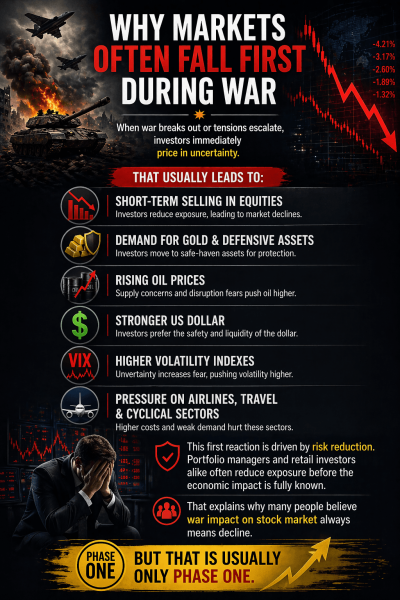
War in energy-sensitive regions can push crude higher. That affects:
- Inflation
- Freight costs
- Airline profitability
- Consumer spending
- Central bank policy
- Corporate margins
If oil spikes sharply and stays elevated, markets may struggle. If oil rises briefly and then normalizes, equities often recover.
That is why investors tracking oil prices and stock market war relationships should monitor Brent crude as closely as headline news.
Can Indian Stock Markets During War rise?
Yes—depending on context the Indian Stock Market During War may rise.
India imports significant energy, so sustained oil spikes can pressure inflation and the rupee. However, Indian equities are also supported by:
- Domestic consumption
- Banking system strength
- Structural growth trends
- Retail investor participation
- Capex cycles
So while oil shocks may create short-term volatility, Indian markets can still recover if domestic growth remains intact.
For searches like Indian stock market during war, the better question is not whether markets fall—but whether earnings expectations remain stable.
Can US Stock Markets Rise During War?
Historically, yes.
US markets often respond to conflict in stages:
- Initial fear-driven decline
- Policy response expectations
- Defense/energy rotation
- Broader recovery if recession risk stays low
Because the US economy is diversified and capital markets are deep, investors frequently return once uncertainty becomes clearer.
That is why queries such as US stock market during war remain highly relevant during global crises.
Can Canada Benefit During Oil-Driven Conflict?
Canada presents a mixed but interesting case.
As an energy producer, higher crude prices can support:
- Energy company earnings
- Trade balances
- Certain provincial economies
At the same time, consumers may face inflationary pressure.
So Canadian markets may see sector divergence rather than uniform decline.
Which Sectors Often Perform Better During Conflict Periods?
When investors ask best sectors during war, history often points to:
Energy
Oil and gas producers may benefit from higher crude pricing.
Defense
Government procurement expectations can lift sentiment.
Commodities
Gold, metals, and select raw materials may gain safe-haven demand.
Utilities
Stable cash-flow businesses may attract defensive investors.
Which Sectors Can Face Pressure?
Airlines
Fuel costs rise quickly.
Travel & Leisure
Consumer confidence may weaken.
Rate-Sensitive Growth Stocks
If inflation rises, rate-cut expectations may fall.
Import-Dependent Businesses
Higher shipping and energy costs can compress margins.
Common Mistakes Investors Make During War Headlines
1. Selling Everything Immediately
Markets often price fear faster than fundamentals.
2. Ignoring Time Horizon
Long-term investors and short-term traders should react differently.
3. Watching Headlines, Not Data
Oil, yields, inflation, and earnings matter more than social media panic.
4. Assuming Every War Becomes Global Recession
Some conflicts remain economically contained.
Strategic Framework: How Smart Investors Think
Instead of asking only can stock markets rise during war, experienced investors ask:
- Is the conflict expanding or contained?
- Are oil prices stabilizing?
- Are earnings forecasts collapsing?
- Are central banks tightening further?
- Which sectors gain from the new environment?
That framework turns emotion into analysis.
What to Watch Right Now During Modern Conflicts
If you are investing during uncertain periods, monitor:
- Brent crude oil prices
- US Treasury yields
- Inflation data
- Currency volatility
- Shipping disruptions
- Earnings revisions
- Index breadth (how many stocks are participating)
These indicators often reveal more than headlines.
Do Markets Recover After War?
Many do. But timing differs.
Markets recover when:
- Economic damage is limited
- Liquidity remains strong
- Inflation cools
- Supply chains normalize
- Earnings remain resilient
This is why stock market recovery after war is one of the most valuable concepts for patient investors.
Internal Linking Suggestions for Your better Learning
Link this article to:
External Reference Suggestions
Readers can deepen understanding through:
Conclusion: Can Stock Markets Rise During War?
Yes, stock markets can rise during war—and history shows they often do after the initial shock phase.
Markets are not voting on morality or emotion. They are pricing future earnings, liquidity, policy response, and whether worst-case fears become reality.
That does not mean every conflict is bullish. Severe, prolonged wars with energy disruption and inflation shocks can hurt markets materially. But assuming all wars cause lasting crashes is often inaccurate.
For disciplined investors, the better approach is to study data, sector rotation, and macro signals rather than react to headlines alone.
Understanding that distinction can be a major edge.
Frequently Asked Questions
1. Can stock markets rise during war?
Yes. Markets often fall initially but can recover if economic damage is lower than feared.
2. Which stocks do well during war?
Energy, defense, commodities, and defensive sectors sometimes outperform.
3. Why do markets recover during conflict?
Because markets price future expectations once uncertainty becomes clearer.
Final Note
If you want structured financial insights, subscribe for regular updates.
Serious investing often begins when emotion ends and analysis starts.























Post Comment