Quick Answer: SEBI F&O Margin Rules July 2025 Impact on Small Traders Explained
SEBI’s new F&O margin rules, effective July 2025, significantly increase the minimum capital required to trade futures and options on NSE and BSE. Small traders with accounts under ₹2–5 lakh are most affected, as higher margin requirements mean they can no longer enter many positions they previously could. These rules aim to protect retail investors from catastrophic losses in derivatives trading.
The SEBI F&O margin rules July 2025 impact on small traders is one of the most important regulatory changes in India’s derivatives market. These new SEBI F&O margin rules July 2025 have increased capital requirements and reduced trading flexibility for retail investors, especially those with smaller accounts.
Introduction The Rule Change That Is Shaking Up Every Small Trader Strategy
Imagine you have been trading weekly Nifty 50 options every Thursday with ₹50,000 in your account. You have learned the basics and are getting comfortable. Then overnight, the minimum margin requirement jumps so high that your entire account balance barely covers a single lot. That is the reality thousands of small traders across India are facing in 2025.
SEBI’s own data from 2024 revealed that 9 out of 10 individual F&O traders lose money, with average losses exceeding ₹1.1 lakh per trader per year. In response, the Securities and Exchange Board of India has introduced new margin rules for derivatives trading, with major changes taking effect in July 2025.
Search interest in SEBI F&O margin rules July 2025 impact on small traders has surged sharply, showing how many retail investors are looking for clarity.
By the end of this article, you will understand what these rules change, how they affect your capital, and what alternatives you can consider.
What Is F&O Trading A Simple Explanation
F&O stands for Futures and Options. These are financial contracts that allow you to buy or sell a stock or index at a predetermined price on a future date. Instead of paying the full value, you only pay a portion known as margin. This makes F&O both powerful and risky.
How Margin Works
Margin works like a security deposit. If you want exposure to a ₹5 lakh contract, you may only need ₹30,000–₹50,000 as margin. Under new rules, this requirement has increased significantly.
Why Small Traders Use F&O
F&O allows control over large positions with limited capital. However, SEBI data shows retail traders contribute heavily to volume but also experience the highest losses.
What Changed in July 2025
SEBI introduced multiple changes to reduce risk and speculative trading.
Key Changes
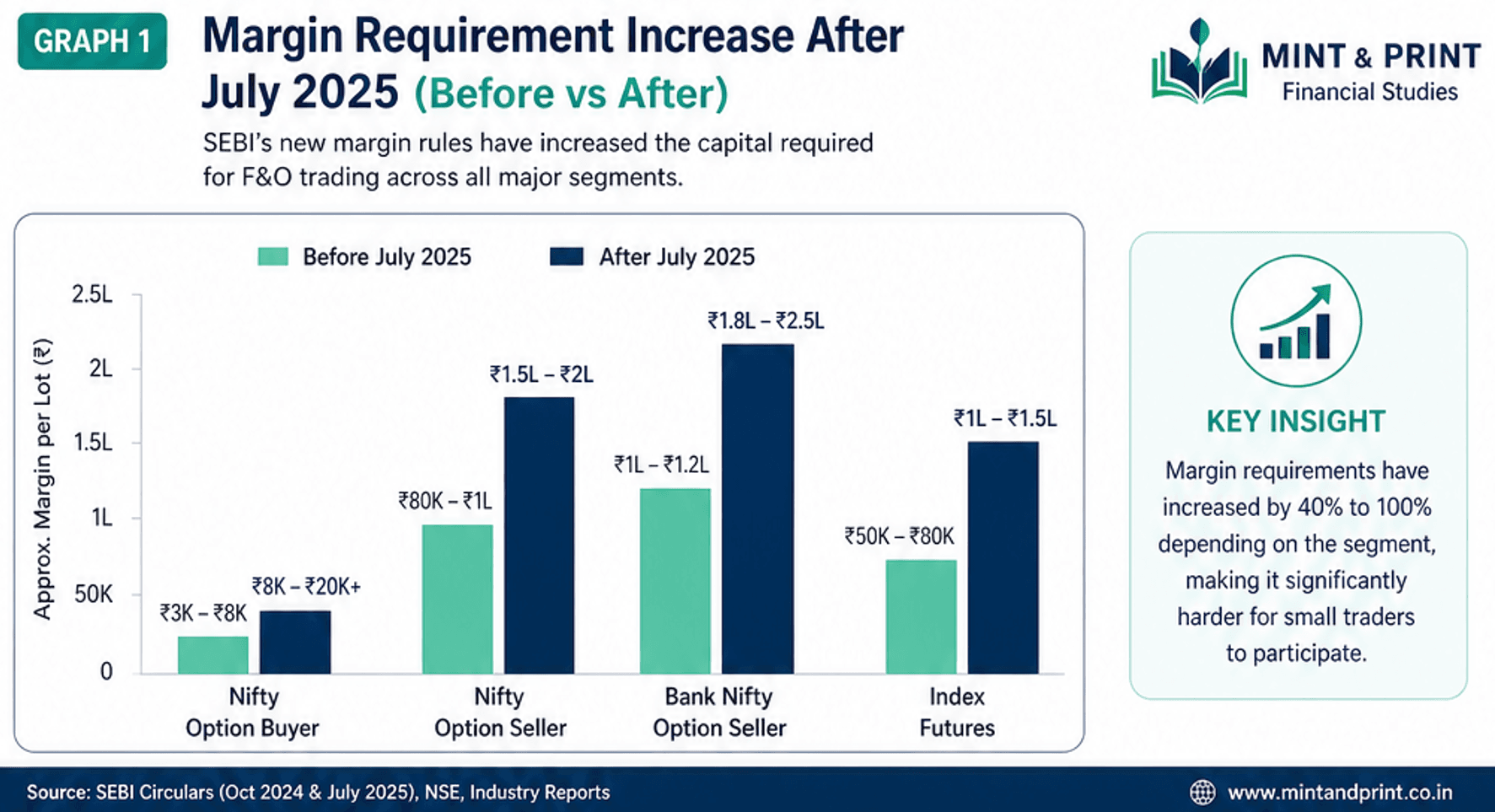
The SEBI F&O margin rules July 2025 impact on small traders is clearly visible in the increased margin requirements across Nifty and Bank Nifty contracts.
Understanding the SEBI F&O margin rules July 2025 impact on small traders helps investors avoid high-risk strategies in derivatives trading.
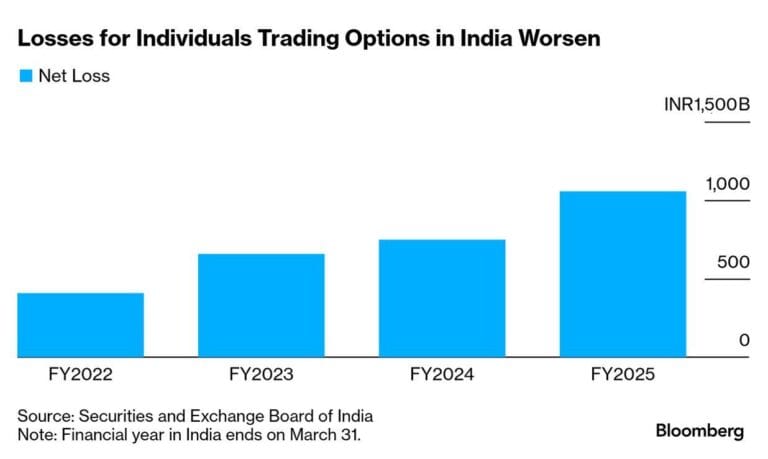
Recent data strongly supports the SEBI F&O margin rules July 2025 impact on small traders, especially when analyzing rising loss trends in the F&O segment.
| Rule |
Before July 2025 |
After July 2025 |
| Minimum contract size |
₹5–6 lakh |
₹15–20 lakh |
| Weekly expiry options |
Multiple indices |
One per exchange |
| Premium collection |
Partial |
100 percent upfront |
| Extreme Loss Margin |
Around 2 percent |
3 to 5 percent |
| Calendar spread benefit |
Allowed |
Removed |
Impact of Lot Size Increase
The increase in lot size means higher capital is required. If Nifty trades at 24,000, one lot may now require ₹1.5–2 lakh margin. Traders with smaller capital may no longer participate effectively.
Weekly Expiry Restriction
Earlier, multiple weekly expiry opportunities existed. Now, only one index per exchange is allowed. This reduces speculative trading frequency.
Real Impact on Small Traders
Case Study One Small Capital Trader
A trader with ₹50,000 earlier could take multiple option positions. Now, higher premium and margin requirements reduce flexibility and trade size.
Case Study Two Option Seller
An options seller who needed ₹1.2 lakh earlier may now require up to ₹2 lakh for the same strategy.
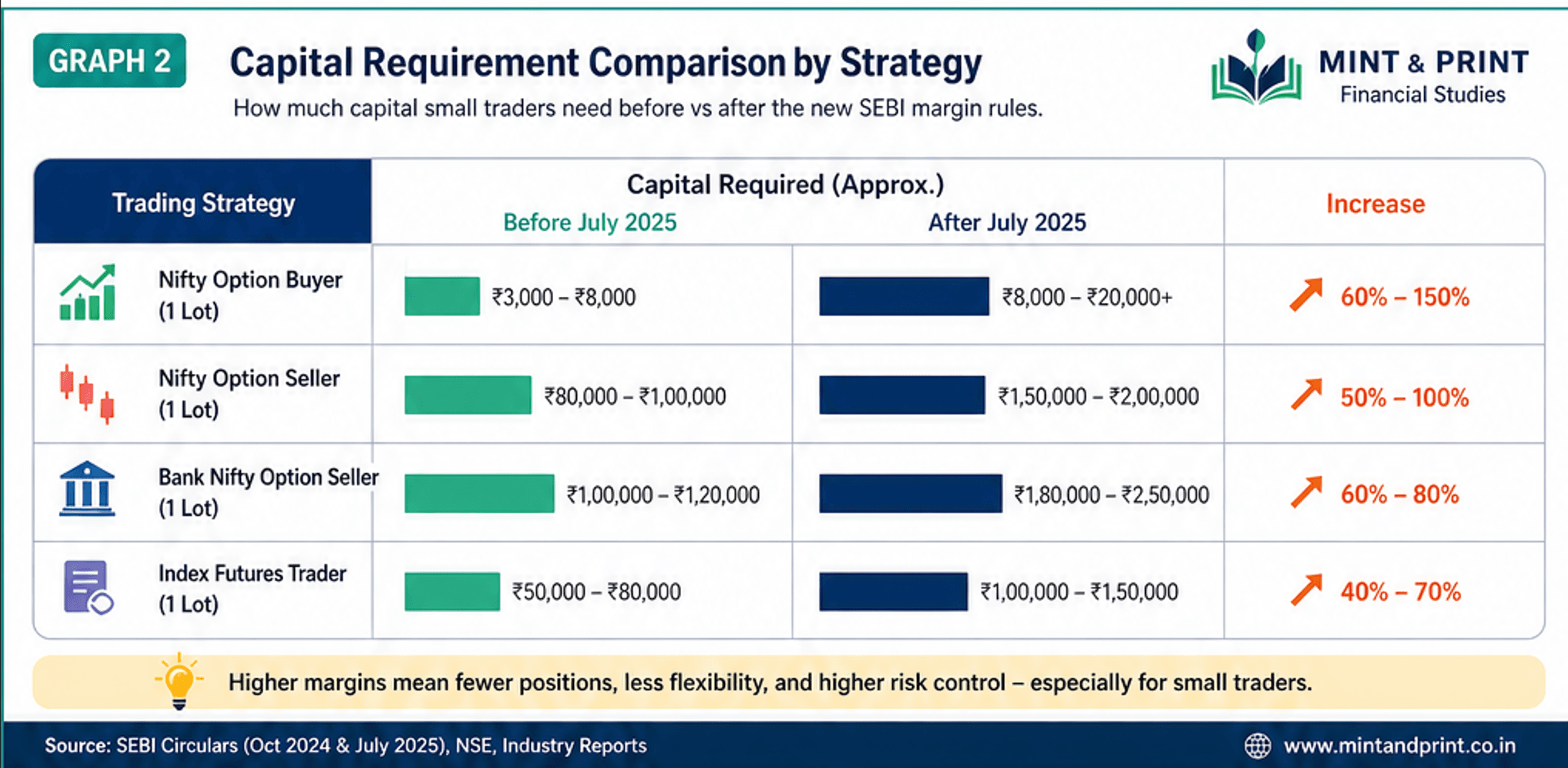
Capital Requirement Comparison
| Trader Type | Before July 2025 | After July 2025 | Change |
|---|
| Option buyer | ₹3,000–₹8,000 | ₹8,000–₹20,000 | Increased |
| Option seller | ₹80,000–₹1 lakh | ₹1.5–₹2 lakh | Increased |
| Bank Nifty seller | ₹1–₹1.2 lakh | ₹1.8–₹2.5 lakh | Increased |
| Futures trader | ₹50,000–₹80,000 | ₹1–₹1.5 lakh | Increased |
Why SEBI Made These Changes
SEBI data shows large-scale losses among retail traders. Over ₹1.81 lakh crore was lost by individual traders between FY2022 and FY2024.
Objective
The goal is to reduce excessive speculation and ensure only financially prepared traders participate in derivatives.
Alternatives for Small Traders
Mutual Funds
Mutual funds allow investment with as little as ₹500 through SIP. They are diversified and professionally managed.
Equity Delivery
Buying stocks directly eliminates leverage risk. You own the asset and can hold it long term.
ETFs
Exchange traded funds offer diversification at low cost and can be bought like stocks.
Key Takeaways
- SEBI margin rules have increased capital requirements significantly
- Over 90 percent of traders lose money in F&O
- Weekly expiry opportunities are now limited
- Small traders face restricted participation
- Alternatives like mutual funds and ETFs are safer for beginners
Frequently Asked Questions
What is the minimum capital required after July 2025
Option buying may require ₹8,000–₹20,000 while selling may need ₹1.5 lakh or more.
Are these rules permanent
Yes, these are long-term regulatory changes.
Can small traders still participate
They can participate as buyers, but selling strategies require higher capital.
Why were weekly expiries reduced
To reduce speculative trading behavior.
Do these rules affect mutual funds
No, mutual funds are not impacted.
To Summarize -
The SEBI F&O margin rules introduced in July 2025 mark a major shift in how retail traders participate in derivatives. While the changes may seem restrictive, they are designed to reduce financial risk and protect small investors.
The smarter approach is to build knowledge, increase capital gradually, and choose investment methods that align with your financial capacity.
Understanding these rules is the first step toward making better financial decisions in the Indian market.
Overall, the SEBI F&O margin rules July 2025 impact on small traders highlights the need for better capital management and safer investment approaches.
Additional External Resources-
Additional Internal Resources-
Disclaimer–
This content is for educational purposes only and does not constitute investment or trading advice.
Please consult a SEBI-registered financial advisor before making any financial decisions.
























Post Comment