How I choose the right mutual fund ??
Over time, I have realized that choosing the right mutual fund is not about chasing the highest returns, but about aligning investments with clear financial goals. Understanding how to choose the right mutual fund has helped me bring structure, discipline, and consistency into my investment decisions.
Mutual funds offer diversification and professional management, but selecting the right one requires a thoughtful and practical approach.
What a Mutual Fund Means to Me
I see a mutual fund as a professionally managed pool of money where my capital is allocated across different asset classes such as equities, debt instruments, or a mix of both.
For me, mutual funds provide:
- Access to expert fund management
- Diversification across multiple assets
- A structured way to participate in financial markets
How I Understand Different Types of Mutual Funds
Before making any decision, I categorize mutual funds based on their purpose:
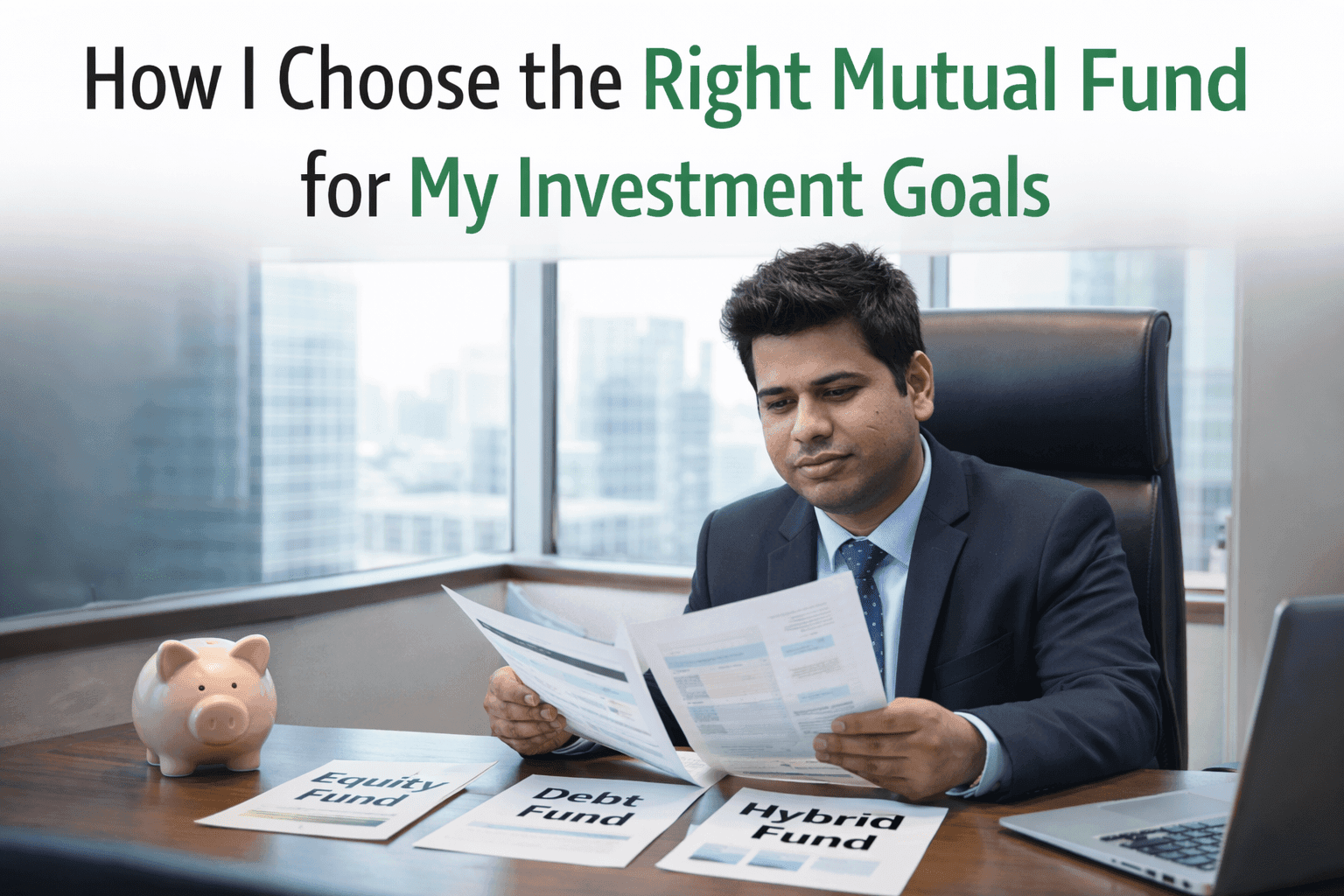
Equity Funds
I consider these when my goal is long-term wealth creation. They come with higher risk but offer better growth potential over time.
Debt Funds
I prefer these when stability and predictable returns are more important. These are suitable when I want lower volatility.
Hybrid Funds
When I want a balance between growth and stability, I look at hybrid funds that combine equity and debt.
Risks I Always Keep in Mind
Before I choose the right mutual fund, I evaluate the risks involved:
- Market risk due to price fluctuations
- Credit risk in case of default in debt instruments
- Interest rate risk affecting bond values
- Liquidity risk in less tradable assets
Understanding these risks helps me make more informed decisions rather than emotional ones.
My Approach to Choosing the Right Mutual Fund
Over time, I have developed a simple but effective framework:
1. I Start with My Investment Goal
I clearly define whether I am investing for long-term growth, regular income, or capital preservation.
2. I Assess My Risk Tolerance
I match my comfort level with the type of fund:
- Higher risk tolerance leads me toward equity funds
- Moderate risk suits hybrid funds
- Lower risk aligns with debt funds
3. I Look at Consistent Performance
Instead of focusing on short-term returns, I study how the fund has performed over 3 to 5 years.
4. I Evaluate the Fund Manager
The consistency and experience of the fund manager play an important role in my decision-making process.
5. I Pay Attention to Expense Ratio
Even a small difference in costs can impact long-term returns, so I prefer funds with reasonable expense ratios.
6. I Check the Fund Size (AUM)
I avoid extremely small or excessively large funds and look for a balanced size that allows flexibility and stability.
Mistakes I Avoid While Investing
Through experience, I have learned to avoid:
- Chasing recent top-performing funds
- Ignoring my own risk profile
- Over-diversifying without purpose
- Making decisions based on market noise
My Simple Investment Philosophy
To keep things practical, I follow a disciplined approach:
- I align every investment with a clear goal
- I focus on consistency rather than short-term gains
- I keep costs under control
- I stay invested with a long-term perspective
Final Thoughts
For me, learning how to choose the right mutual fund has been about clarity rather than complexity. There is no single “best” fund — only the fund that fits my financial situation, goals, and mindset.
When investments are aligned with purpose and discipline, the outcomes tend to be more stable and predictable over time.
Disclaimer
This content is intended for educational purposes only and does not constitute investment advice. Investment decisions should be made based on individual financial goals, risk tolerance, and consultation with a qualified financial professional.




















Post Comment