What is a Stock Market Crash?
Introduction:
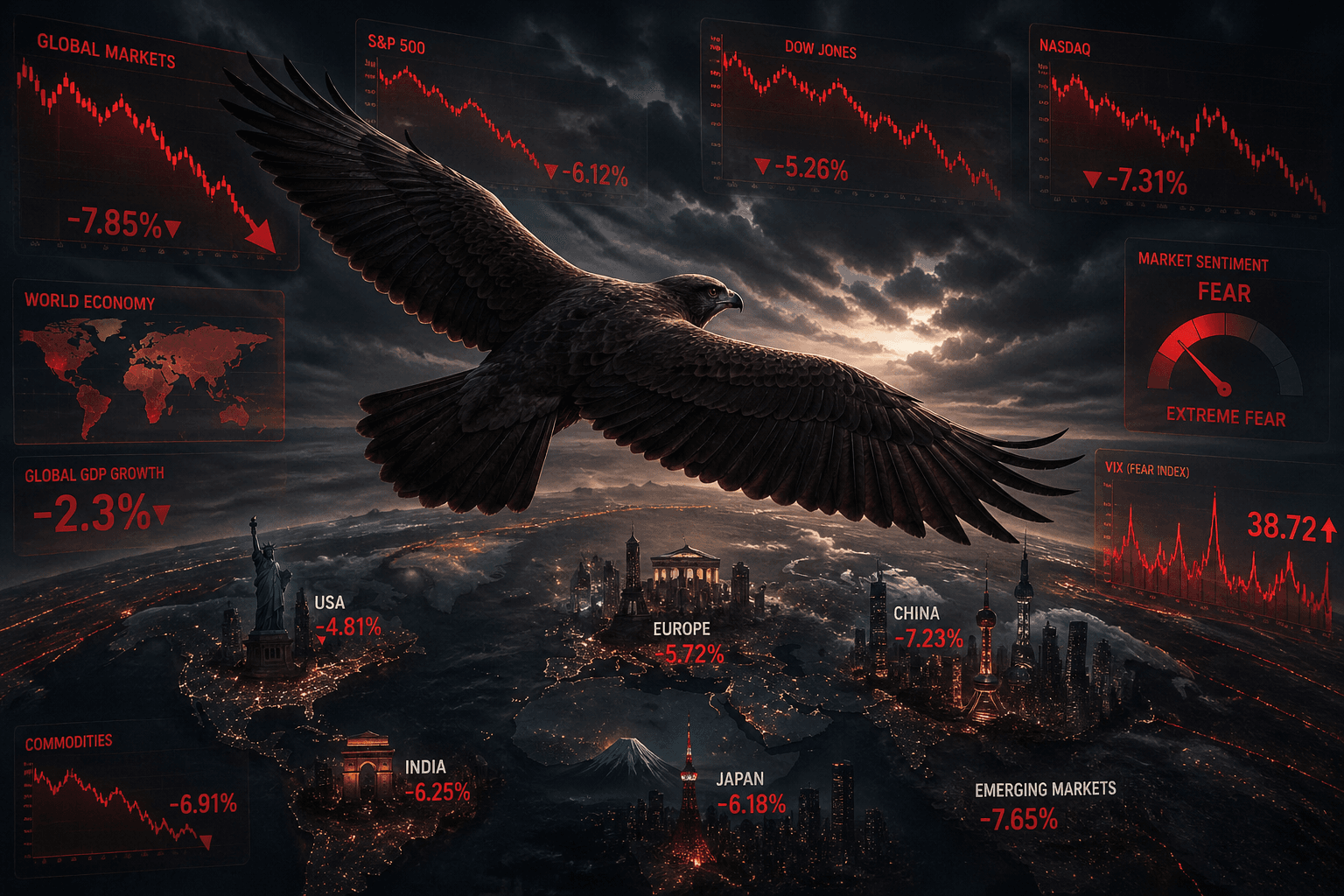
A stock market crash is one of the most dramatic and feared events in financial markets. It refers to a sudden and sharp decline in stock prices across a major section of the market within a short period of time.
Unlike normal market corrections, a stock market crash is:
- Rapid
- Widespread
- Driven by panic
In simple terms, when investors start selling aggressively due to fear, uncertainty, or economic stress, the result is a market-wide collapse in prices, known as a stock market crash.
This guide will help you understand:
- What a stock market crash is
- Why it happens
- Real-world examples
- How to protect your investments
What is a Stock Market Crash?
A stock market crash is a sudden fall of 10% or more in stock market indices within a few days or weeks, caused by panic selling and economic triggers.
Key characteristics:
- Sharp price decline
- High volatility
- Massive sell-offs
- Fear-driven behavior
A crash is not just about numbers — it reflects investor psychology and economic stress combined.
Market Crash vs Bear Market
Many beginners confuse these two.
| Factor |
Stock Market Crash |
Bear Market |
| Speed |
Sudden (days) |
Gradual (months/years) |
| Cause |
Panic + trigger event |
Economic slowdown |
| Emotion |
Fear & panic |
Cautious pessimism |
| Duration |
Short-term |
Long-term |
A stock market crash can lead to a bear market, but not always.
What Causes a Stock Market Crash?
A stock market crash usually doesn’t happen randomly. It builds over time and then gets triggered suddenly.
1. Overvaluation and Market Bubbles
When stock prices rise far beyond their actual value, a bubble forms.
Eventually, reality catches up → prices fall sharply.
2. Excessive Investor Optimism
When everyone believes markets will only go up:
- Risk increases
- Caution disappears
- Crashes become more likely
3. High Leverage (Borrowed Investing)
Investors using borrowed money (margin):
- Forced selling when prices drop
- Accelerates the crash
4. Economic Triggers
- Interest rate hikes
- Inflation
- Recession fears
- Policy changes
5. Global Events
- Wars
- Pandemics
- Political instability
- Trade tensions
6. Panic Selling (Herd Behavior)
This is the biggest factor : When some investors sell → others follow → panic spreads → market crashes.
How a Stock Market Crash Actually Happens (Step-by-Step)
- Market rises strongly (bull phase)
- Valuations become expensive
- Negative news appears
- Big investors start selling
- Prices begin falling
- Retail investors panic
- Massive sell-off → crash
This is often called a feedback loop of fear.
Top Historical Crashes
- Triggered the Great Depression
- Market fell nearly 89%
- Caused global economic collapse
- Single-day fall of 22%
- One of the fastest crashes in history
- Caused by housing bubble & banking collapse
- Global markets crashed massively
- Sensex fell from 21,000 to 8,000
- Markets fell rapidly due to pandemic panic
- Recovered quickly due to stimulus
- Triggered by global trade tensions & tariffs
- Short-term crash followed by recovery
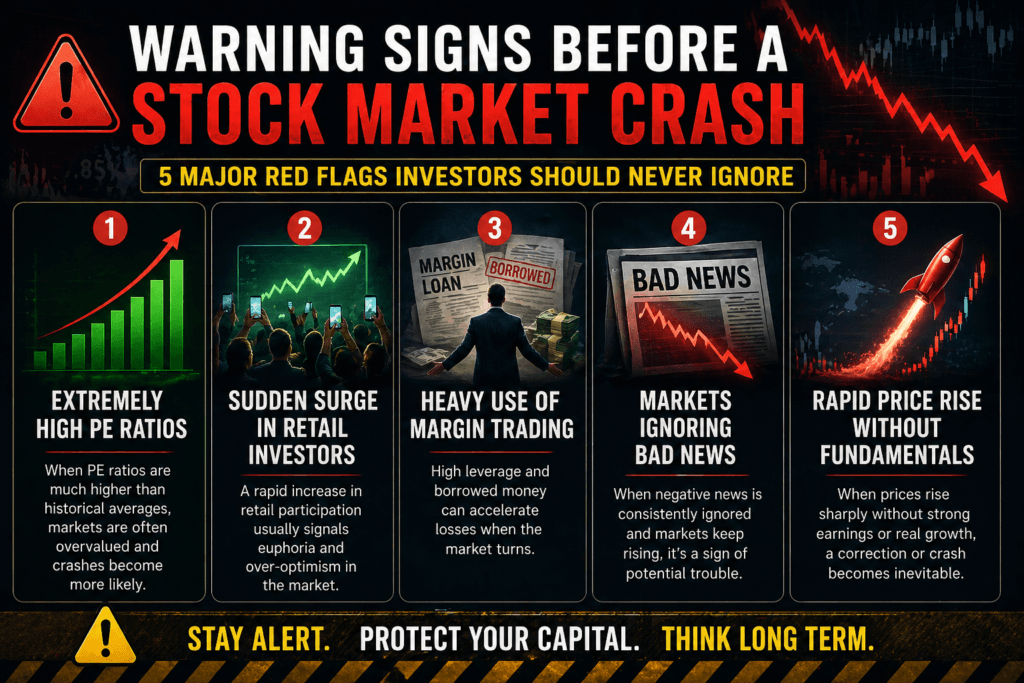
Early Warning Signs of a Market Crash
Extremely high PE ratios | Sudden surge in retail investors | Heavy use of margin trading | Markets ignoring bad news | Rapid price rise without fundamentals
- Stock prices fall rapidly
- Investors panic
- Liquidity reduces
- Volatility increases
- Governments may intervene
Circuit Breakers
Stock exchanges use circuit breakers:
- Pause trading temporarily
- Prevent extreme panic selling
Impact of Crash on various Pillars
Do Stock Markets Always Recover?
Yes — historically, markets always recover.
Examples:
- 1929 → Long recovery
- 2008 → Recovered in ~5 years
- 2020 → Recovered within months
Key insight:
Crashes are temporary, growth is long-term.
How to Survive a Market Crash
1. Don’t Panic Sell
Selling during panic locks in losses.
2. Stay Invested
Long-term investing helps recover losses.
3. Diversify Your Portfolio
Avoid concentration risk.
4. Keep Cash Ready
Crashes create buying opportunities.
5. Focus on Strong Companies
Quality stocks bounce back faster.
6. Avoid Over-Leverage
Debt increases risk during crashes.
Investment Strategy During a Crash
Smart investors follow these strategies:
- Buy in phases (not all at once)
- Invest in index funds
- Focus on long-term growth
- Ignore short-term noise
Can You Predict a Stock Market Crash?
No one can predict crashes with certainty.
But you can:
- Track valuations
- Monitor global economy
- Observe investor sentiment
Crashes are inevitable but unpredictable.
Psychology Behind a Stock Market Crash
A market crash is driven more by human emotions than data.
Key emotions:
- Greed (during rise)
- Fear (during fall)
This creates:
- Bubbles
- Panic selling
- Overreaction
Opportunities During a Stock Market Crash
A stock market crash is not just risk — it’s also opportunity.
Benefits:
- Buy quality stocks at discount
- Long-term wealth creation
- Portfolio rebalancing
Many successful investors build wealth during crashes.
Stock Market Crash in India: What You Should Know
India has experienced several market corrections:
- 2008 crash
- 2020 COVID crash
Indian markets:
- Recover relatively fast
- Driven by strong growth
Final Thoughts:
A stock market crash is a natural part of financial markets. It is:
- Inevable
- Temporary
- Opportunity-driven
The right mindset:






















Post Comment