How to Start SIP in Mutual Funds: A Complete Beginner’s Guide (2026)

In This Article
Toggle
Quick Answer of How to Start SIP in Mutual Funds:-
A Systematic Investment Plan (SIP) lets you invest a fixed amount — as low as ₹500 per month — into a mutual fund at regular intervals. To start a SIP, complete your KYC, choose a mutual fund category that matches your goal and risk appetite, and set up auto-debit on any investment platform. SIPs use rupee cost averaging to reduce the impact of market volatility, making them one of the most beginner-friendly ways to invest in India.
Introduction
You earn a salary every month. You pay rent, bills, and maybe splurge on the weekend. But at the end of the month, you’re left wondering: where did all the money go?
Here’s a truth most people discover too late — wealth is not built by earning more. It is built by investing consistently, even small amounts, over a long period of time.
That’s exactly what a SIP (Systematic Investment Plan) does for you.
In India, over ₹26,000 crore is invested via SIPs every single month as of 2026. Millions of first-time investors — students, salaried professionals, homemakers — have quietly begun building wealth, one ₹500 investment at a time.
In this guide, you will learn:
- What a SIP is and how it actually works
- How to start a SIP step-by-step (even with zero finance knowledge)
- Which type of mutual fund is best for beginners in 2026
- How much returns you can realistically expect
- Tax rules you must know before investing
- Common mistakes that cost beginners money
Let’s start from zero.
What Is a SIP? (Simple Explanation for Beginners)
SIP stands for Systematic Investment Plan. It is not a product by itself — it is a method of investing in a mutual fund.
Think of it like a recurring deposit (RD) at a bank, but instead of earning a fixed 6–7% interest, your money is invested in the stock market or bonds — and over the long term, it has historically delivered 10–14% annual returns.
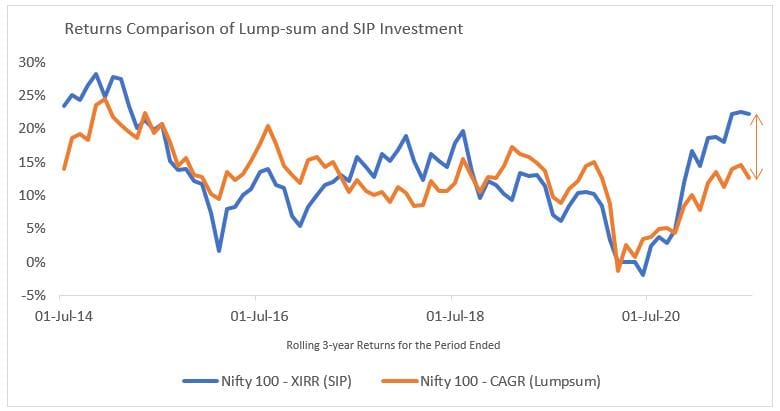
Here’s the key difference from a lump sum investment:
| Feature | SIP | Lump Sum |
|---|---|---|
| Investment frequency | Monthly / quarterly | One-time |
| Minimum amount | ₹500/month | ₹1,000–5,000 |
| Market timing needed? | No | Yes |
| Best for | Salaried beginners | Those with surplus cash |
| Risk level | Lower (averaged out) | Higher (timing-dependent) |
With a SIP, every month a fixed amount is automatically debited from your bank account and used to purchase units of your chosen mutual fund. The number of units you get depends on that day’s NAV (Net Asset Value) — the price of one unit of the fund.
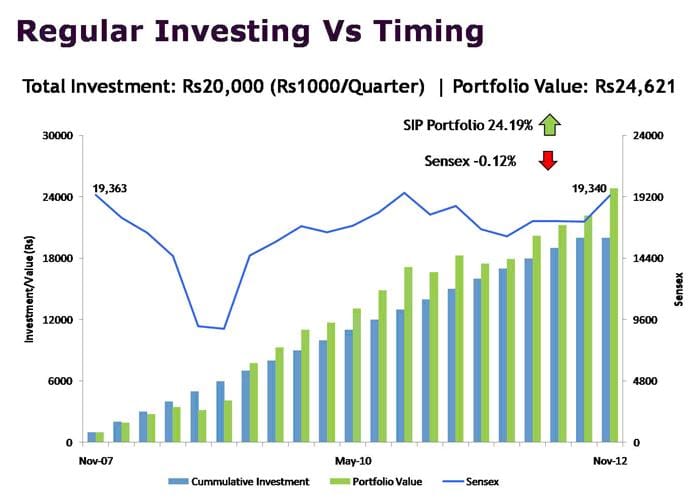
When the market falls, your ₹500 buys more units. When it rises, it buys fewer. Over time, this averaging effect — called rupee cost averaging — reduces your overall cost per unit and lowers your risk significantly.

How Does a SIP Work? (Step-by-Step Mechanics)
Let’s say you start a ₹2,000/month SIP in a large-cap equity mutual fund.
Month 1: NAV = ₹100 → you get 20 units
Month 2: Market falls. NAV = ₹80 → you get 25 units
Month 3: Market recovers. NAV = ₹120 → you get 16.67 units
After 3 months, you have invested ₹6,000 and own 61.67 units. Your average cost per unit is ₹97.29 — lower than the current price of ₹120.
This is the magic of rupee cost averaging in action.
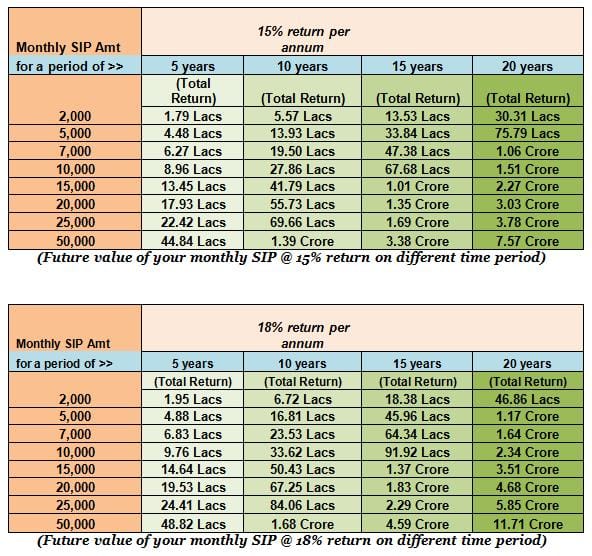
Over 10 years at a modest 12% annual return, a monthly SIP of just ₹3,000 grows to approximately ₹7 lakh from a total investment of ₹3.6 lakh. That’s nearly double your money — just from discipline and compounding.
Types of Mutual Funds for SIP — Which One Should a Beginner Choose?
Not all mutual funds are the same. As a beginner, the type of fund you pick should match your goal, time horizon, and risk tolerance.
1. Index Funds (Best for Absolute Beginners)
Index funds passively track a market index like the Nifty 50 or Sensex. They don’t try to beat the market — they simply mirror it.
Why beginners love them:
- Very low expense ratio (0.10–0.20%)
- No fund manager risk
- Consistent long-term performance
- 5-year returns: approximately 14–18% CAGR
Example: UTI Nifty 50 Index Fund, HDFC Index Fund – Nifty 50 Plan
2. Large-Cap Equity Funds (Low-to-Medium Risk)
These funds invest in the top 100 companies in India by market capitalization — names like Reliance, HDFC Bank, Infosys, and TCS. These are stable, established companies.
Why they work for beginners:
- Lower volatility than mid or small-cap funds
- Consistent dividend history
- Great for a 5–10 year horizon
Example: ICICI Prudential Bluechip Fund, Nippon India Large Cap Fund
3. Balanced Advantage Funds / Hybrid Funds (For the Risk-Averse)
These funds dynamically adjust the mix of equity and debt based on market conditions. When the market is expensive, they reduce equity exposure. When cheap, they increase it.
Why beginners like them:
- Less volatile than pure equity funds
- Automatic rebalancing
- Good starting point if you’re nervous about stock market risk
Example: HDFC Balanced Advantage Fund, ICICI Prudential Balanced Advantage Fund
4. ELSS Funds (Tax-Saving SIP — Best for Salaried Individuals)
ELSS (Equity Linked Savings Scheme) is the only mutual fund that offers a tax deduction under Section 80C — up to ₹1.5 lakh per year. It has the shortest lock-in period (3 years) among all 80C investments.
Why it’s special:
- Save up to ₹46,800 in taxes per year (for 30% tax bracket)
- Invest in equities while getting a tax benefit
- Historical returns: 12–15% CAGR over 5 years

How Does a SIP Work? (Step-by-Step Mechanics)

Let’s say you start a ₹2,000/month SIP in a large-cap equity mutual fund.
Month 1: NAV = ₹100 → you get 20 units
Month 2: Market falls. NAV = ₹80 → you get 25 units
Month 3: Market recovers. NAV = ₹120 → you get 16.67 units
After 3 months, you have invested ₹6,000 and own 61.67 units. Your average cost per unit is ₹97.29 — lower than the current price of ₹120.
This is the magic of rupee cost averaging in action.
Over 10 years at a modest 12% annual return, a monthly SIP of just ₹3,000 grows to approximately ₹7 lakh from a total investment of ₹3.6 lakh. That’s nearly double your money — just from discipline and compounding.
Types of Mutual Funds for SIP — Which One Should a Beginner Choose?
Not all mutual funds are the same. As a beginner, the type of fund you pick should match your goal, time horizon, and risk tolerance.
1. Index Funds (Best for Absolute Beginners)
Index funds passively track a market index like the Nifty 50 or Sensex. They don’t try to beat the market — they simply mirror it.
Why beginners love them:
- Very low expense ratio (0.10–0.20%)
- No fund manager risk
- Consistent long-term performance
- 5-year returns: approximately 14–18% CAGR
Example: UTI Nifty 50 Index Fund, HDFC Index Fund – Nifty 50 Plan
2. Large-Cap Equity Funds (Low-to-Medium Risk)
These funds invest in the top 100 companies in India by market capitalization — names like Reliance, HDFC Bank, Infosys, and TCS. These are stable, established companies.
Why they work for beginners:
- Lower volatility than mid or small-cap funds
- Consistent dividend history
- Great for a 5–10 year horizon
Example: ICICI Prudential Bluechip Fund, Nippon India Large Cap Fund
3. Balanced Advantage Funds / Hybrid Funds (For the Risk-Averse)
These funds dynamically adjust the mix of equity and debt based on market conditions. When the market is expensive, they reduce equity exposure. When cheap, they increase it.
Why beginners like them:
- Less volatile than pure equity funds
- Automatic rebalancing
- Good starting point if you’re nervous about stock market risk
Example: HDFC Balanced Advantage Fund, ICICI Prudential Balanced Advantage Fund
4. ELSS Funds (Tax-Saving SIP — Best for Salaried Individuals)
ELSS (Equity Linked Savings Scheme) is the only mutual fund that offers a tax deduction under Section 80C — up to ₹1.5 lakh per year. It has the shortest lock-in period (3 years) among all 80C investments.
Why it’s special:
- Save up to ₹46,800 in taxes per year (for 30% tax bracket)
- Invest in equities while getting a tax benefit
- Historical returns: 12–15% CAGR over 5 years
How to Start a SIP in Mutual Funds — Step-by-Step Guide

Here is the exact process to make your first SIP investment in India in 2026.
Step 1: Complete Your KYC
KYC (Know Your Customer) is mandatory for all mutual fund investments in India. You need:
- PAN card
- Aadhaar card
- A selfie or video verification
KYC is a one-time process and can be completed entirely online in under 10 minutes.
Step 2: Choose Your Investment Platform
You can invest in direct mutual funds (zero commission) through:
- Zerodha Coin — best for existing Zerodha users
- Groww — simplest interface, ideal for first-timers
- Paytm Money — easy to use, good fund selection
- AMC website directly — e.g., hdfc.mf.com, sbiamcmf.com
Tip: Always choose Direct Plans over Regular Plans. Direct plans have lower expense ratios since there is no distributor commission — this can improve your returns by 0.5–1% annually, which compounds to lakhs over 10–15 years.
Step 3: Define Your Investment Goal
Before you pick a fund, answer these three questions:
- What am I investing for? (Emergency fund? Retirement? Child’s education? A car in 3 years?)
- For how long can I stay invested?
- How much risk am I comfortable with?
Your goal determines your fund type:
- Goal in 1–3 years → Debt fund or hybrid fund
- Goal in 3–7 years → Large-cap or balanced advantage fund
- Goal in 7+ years → Flexi-cap, mid-cap, or index fund
Step 4: Choose Your Fund and SIP Amount
Based on your research, pick one or two funds to start. You don’t need five funds as a beginner — too many funds actually reduce diversification efficiency.
Recommended starter portfolio for a beginner (₹3,000/month budget):
- ₹1,500 → Nifty 50 Index Fund (stability and market returns)
- ₹1,500 → ELSS Fund (tax saving + equity growth)
As your income grows, increase the SIP amount. Even a 10% annual SIP top-up dramatically accelerates your corpus.
Step 5: Set Up Auto-Debit and Start
Select the fund, set the monthly SIP date (1st or 5th of the month is popular), link your bank account, and authorize the auto-debit mandate. Done.
The first deduction will happen within 30 days. After that, your SIP runs on autopilot — you don’t need to do anything.
Lorem ipsum dolor sit amet, consectetur adipiscing elit. Ut elit tellus, luctus nec ullamcorper mattis, pulvinar dapibus leo.
This is How Much Can You Really Earn from SIP? (Realistic Returns)a title

Let’s look at some real scenarios based on historical Indian equity market performance.
Assuming 12% annual CAGR (conservative equity estimate):
| Monthly SIP | 5 Years | 10 Years | 20 Years |
|---|---|---|---|
| ₹500 | ₹40,930 | ₹1,16,170 | ₹4,99,574 |
| ₹2,000 | ₹1,63,712 | ₹4,64,678 | ₹19,98,295 |
| ₹5,000 | ₹4,09,279 | ₹11,61,695 | ₹49,95,738 |
| ₹10,000 | ₹8,18,559 | ₹23,23,391 | ₹99,91,479 |
Key insight: ₹5,000/month for 20 years at 12% = nearly ₹50 lakh. Your total investment? Only ₹12 lakh. The rest — ₹38 lakh — is pure compounding.
Note: Past performance does not guarantee future returns. The above figures are illustrative calculations only. Actual returns will vary based on market conditions and fund selection.
SIP Tax Rules Every Beginner Must Know
Mutual fund gains are taxable in India. Here’s a quick breakdown:
Equity Mutual Funds (including Index Funds):
- Gains held for less than 1 year → Short-Term Capital Gains (STCG) taxed at 20%
- Gains held for more than 1 year → Long-Term Capital Gains (LTCG) taxed at 12.5% on gains exceeding ₹1.25 lakh per year
Debt Mutual Funds (as of April 2023 amendment):
- All gains now taxed at your income tax slab rate, regardless of holding period
ELSS Funds:
- Gains after the 3-year lock-in are taxed as LTCG at 12.5% above ₹1.25 lakh
Important: In a SIP, every monthly instalment is treated as a separate investment for tax purposes. So each instalment has its own 1-year holding period clock. Consult a qualified tax advisor for personalised advice.
5 Common SIP Mistakes Beginners Make (And How to Avoid Them)
Mistake 1: Stopping SIP when the market falls This is the most costly mistake. A falling market means your SIP is buying more units at a lower price — it’s a sale, not a disaster. Stopping the SIP locks in your losses and misses the recovery.
Mistake 2: Choosing a fund based on last year’s returns Last year’s top-performing fund is often this year’s average performer. Focus on 5–10 year consistency, expense ratio, and fund manager track record.
Mistake 3: Investing in too many funds Beginners often spread ₹2,000 across 8–10 funds thinking they’re diversifying. In reality, you’re just holding the same underlying stocks multiple times. Start with 1–2 funds.
Mistake 4: Not increasing SIP amount over time Your salary will grow. Your SIP should too. A simple rule: increase your SIP by 10% every year. This one habit can double your final corpus.
Mistake 5: Redeeming early for non-emergencies SIP works through compounding — and compounding needs time. Redeeming a 3-year SIP to buy a gadget destroys years of growth. Keep an emergency fund separately so your SIP is untouched.
Key Takeaways
- A SIP invests a fixed amount monthly into a mutual fund, starting from just ₹500
- Rupee cost averaging reduces risk by buying more units when prices fall
- For beginners in 2026: start with Nifty 50 Index Fund + ELSS for simplicity and tax savings
- Always choose Direct Plans to save on expense ratios
- The longer you stay invested, the more powerfully compounding works
- Never stop your SIP during market downturns — those are the best months to accumulate
Frequently Asked Questions (FAQ)
Q1: Can I start a SIP with ₹500 per month?
Yes. Most mutual funds in India allow SIPs starting at ₹500 per month. Some platforms like Groww and Zerodha Coin even offer SIPs starting at ₹100.
Q2: Is SIP safe for beginners?
SIPs in equity funds are market-linked and not risk-free. However, the rupee cost averaging mechanism significantly reduces timing risk. For lower risk, beginners can start with hybrid or large-cap funds.
Q3: How many years should I stay invested in a SIP?
A minimum of 5 years is recommended for equity SIPs, but the real benefits of compounding are most visible after 10+ years. The longer you stay, the better.
Q4: What happens if I miss a SIP instalment?
Missing one month will not cancel your SIP. Most fund houses simply skip that month. If you miss 3 consecutive instalments, your SIP may get paused. You can restart it anytime.
Q5: Can I stop my SIP anytime?
Yes. SIPs are completely flexible. You can pause, stop, or modify your SIP amount at any time without any penalty. There is no lock-in (except for ELSS funds which have a 3-year lock-in).
Q6: Direct plan vs regular plan — which is better?
Direct plans are better for most investors as they have lower expense ratios (no distributor commission), which means higher returns over time. The difference of 0.5–1% annually can compound to a significant amount over 10–15 years.
Conclusion
Starting a SIP is one of the simplest, most powerful financial decisions you can make in your 20s or 30s.
You don’t need a lot of money. You don’t need to understand the stock market deeply. You don’t need to time the market. You just need to start — and stay consistent.
₹500 a month, every month, for 20 years. That’s all it takes to let compounding do the heavy lifting for you.
If you’re ready to deepen your understanding of mutual funds, markets, and financial planning, explore the Study Material section on Mint & Print — we break down every concept from NAV to ELSS to fundamental analysis in plain, simple language.
And if you’re preparing for your NISM certification, check out our Research Lab for structured study guides and market analysis.
This article is for educational purposes only and does not constitute investment advice. Mutual fund investments are subject to market risks. Please read all scheme-related documents carefully before investing. Mint & Print is a NISM-certified financial education platform. We are not SEBI registered investment advisors.
Author: Founder Desk — Amit K Sharma | NISM Certified
Category: Study Material / Indian Market
Tags: SIP, Mutual Funds, Beginners Guide, SIP Investment India, Index Fund, ELSS, Rupee Cost Averaging, Personal Finance India
Internal Links: Study Material, Indian Market, Research Lab
External Links: AMFI India (amfiindia.com), SEBI (sebi.gov.in)



















Post Comment