Recession vs Stock Market Crash:
Introduction
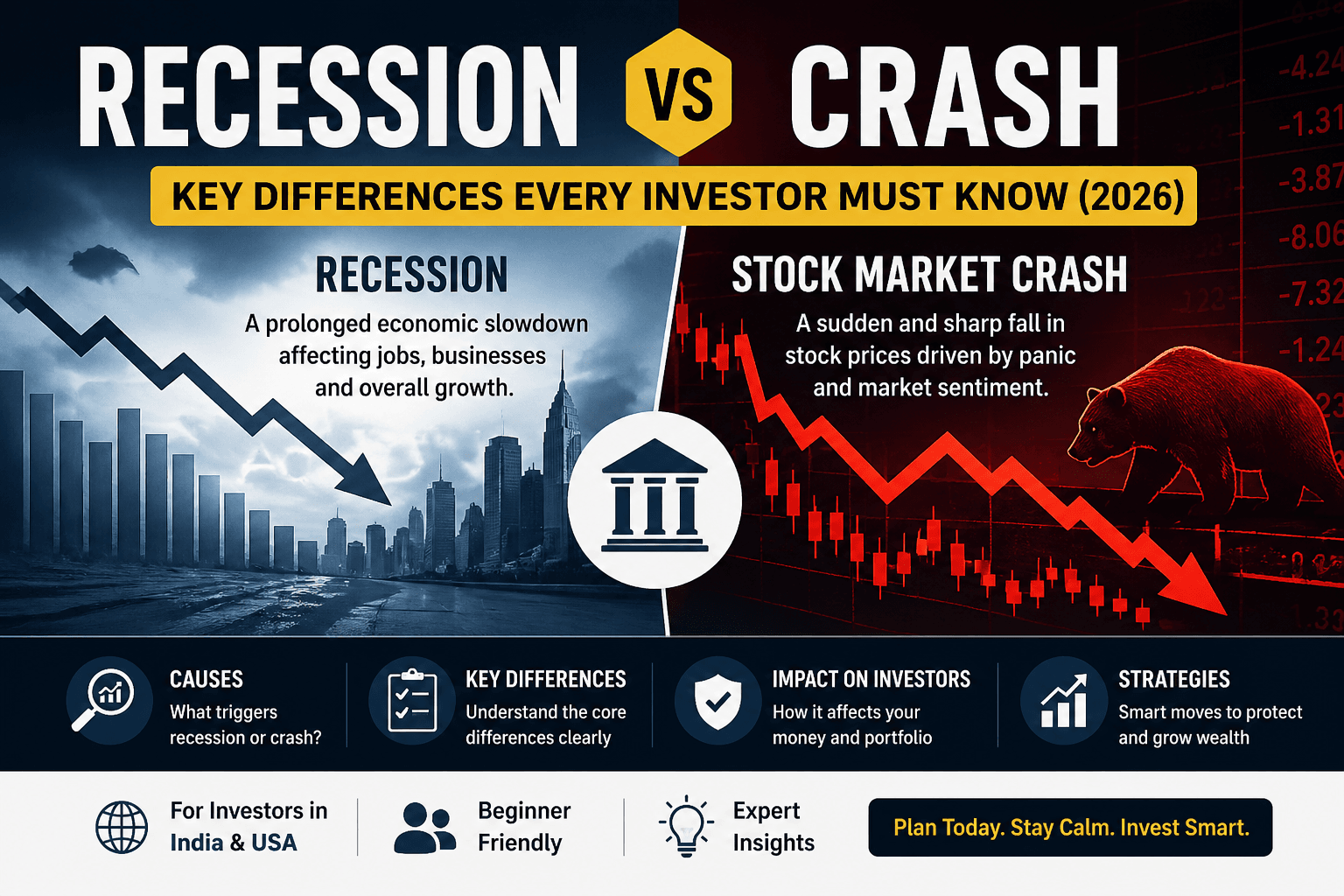
Understanding the difference between recession vs stock market crash is essential for every investor. While both events can create fear and uncertainty, they are not the same. A recession is a slowdown in economic activity, whereas a stock market crash is a sudden and sharp fall in stock prices. Knowing how each works can help you protect your investments and make smarter financial decisions during uncertain times.
If you’ve been following financial news lately, you’ve probably heard two terms used frequently — recession and stock market crash.
Many people assume they are the same.
But in reality, they are very different events, and understanding this difference can save you money, reduce panic, and improve your investment decisions.
In simple terms:
- A recession affects the entire economy
- A stock market crash affects financial markets quickly and sharply
In this guide, you’ll learn:
- What is a recession
- What is a stock market crash
- Key differences (with real examples)
- What comes first — crash or recession?
- How investors should respond
What is a Recession?
A recession is a period when a country’s economy slows down significantly.
Simple Definition:
A recession occurs when economic activity declines for two consecutive quarters.
Key Signs of Recession:
- Falling GDP growth
- Rising unemployment
- Reduced consumer spending
- Decline in business profits
- Lower industrial production
🇮🇳 🇺🇸 Example:
- 2008 Global Financial Crisis
- COVID-19 recession (2020)
During a recession, businesses struggle, jobs are lost, and growth slows down.
What is a Stock Market Crash?
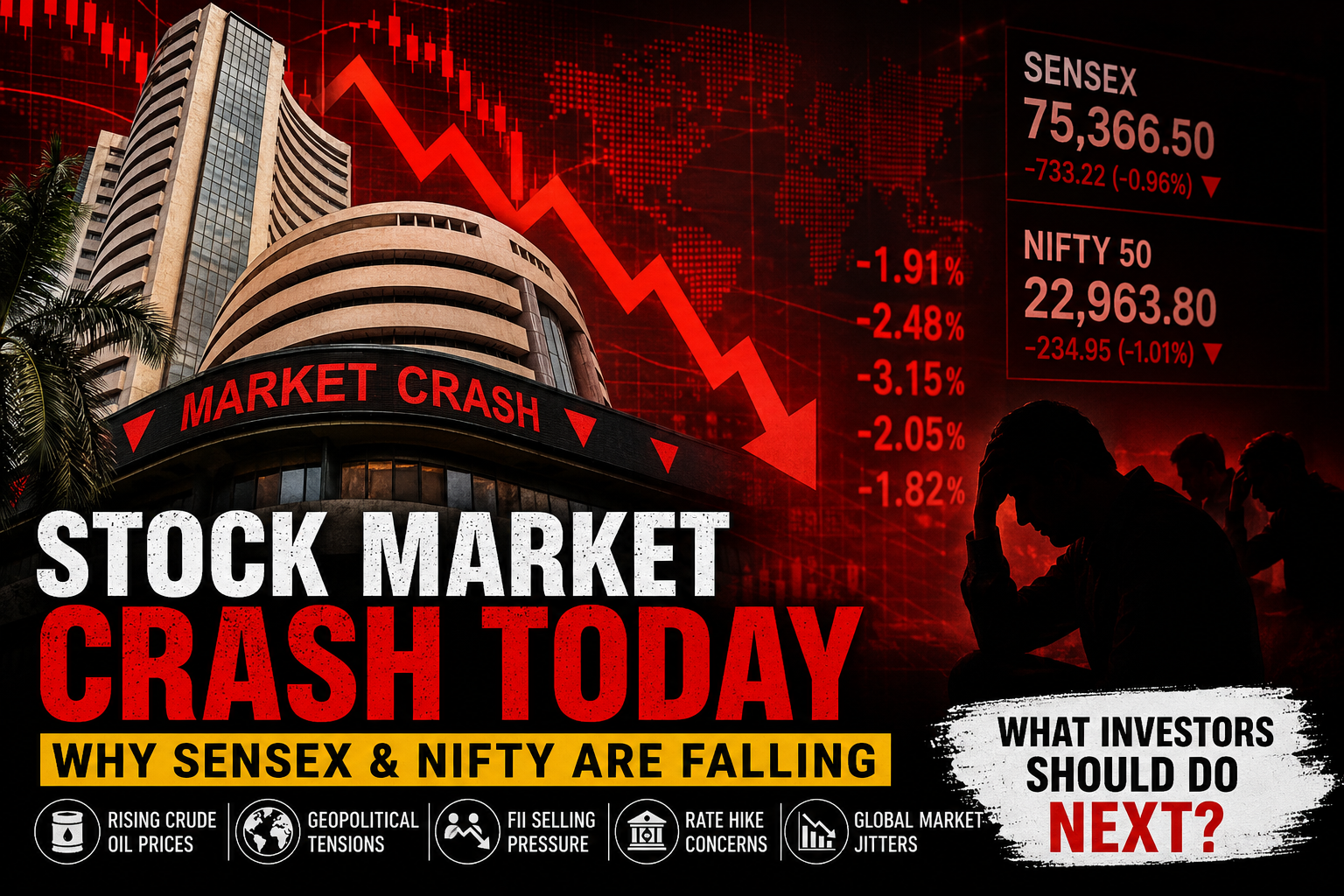
A stock market crash is a sudden and sharp fall in stock prices within a short time.
Simple Definition:
A crash is when markets fall 10%–30% or more within days or weeks.
Key Characteristics:
- Panic selling
- High volatility
- Sudden drop in indices (Nifty, S&P 500, etc.)
- Driven by fear and sentiment
Examples:
- 1929 Wall Street Crash
- Black Monday (1987)
- COVID Crash (March 2020)
A crash happens fast, unlike a recession.
Recession vs Stock Market Crash (Core Differences)
| Factor | Recession | Stock Market Crash |
|---|
| Speed | Slow (months/years) | Fast (days/weeks) |
| Impact | Economy-wide | Market-specific |
| Cause | Economic slowdown | Panic, speculation |
| Predictability | Somewhat predictable | Mostly sudden |
| Duration | Long-term | Short-term (but intense) |
What Comes First: Recession or Market Crash?
This is one of the most searched questions on Google.
The Answer: A stock market crash often comes BEFORE a recession- Why?
Markets are forward-looking. They react to future expectations, not current reality.
Example:
- In 2008, markets crashed before the recession was officially declared
- In 2020, markets crashed even before lockdowns fully impacted economies
Why Do Stock Market Crashes Happen?
Crashes are rarely random. They usually occur when:
- Markets are overvalued (high PE ratios)
- Too many retail investors enter suddenly
- Heavy use of margin trading
- Investors ignore bad news
- Rapid price rise without fundamentals
These are early warning signs smart investors watch closely.
Why Do Recessions Happen?
Recessions are caused by deeper economic issues:
- High inflation
- Rising interest rates
- Global conflicts (war, trade issues)
- Banking crises
- Reduced spending and demand
Real-World Example: 2008 Financial Crisis
Let’s connect both concepts:
- Stock market crashed first
- Banks collapsed
- Economy slowed → recession began
👉 This shows how market crashes can trigger economic downturns
Investor Psychology: The Hidden Factor
Both crashes and recessions are heavily influenced by human behavior:
- Fear → Panic selling
- Greed → Bubble formation
- Herd mentality → Bigger crashes
Understanding psychology gives you a huge edge in markets.
How Should You Respond as an Investor?
During a Market Crash:
- Avoid panic selling
- Look for buying opportunities
- Focus on strong companies
During a Recession:
- Maintain cash reserves
- Avoid risky investments
- Focus on long-term strategy
Long-Term Insight
- Historically Markets always recover after crashes
- HistoricallyEconomies recover after recessions
The key difference is time and patience
FAQs
1. Is a recession the same as a stock market crash?
No. A recession is an economic slowdown, while a crash is a sudden market decline.
2. Can a crash happen without a recession?
Yes. Example: 1987 crash did not lead to a recession.
3. Can a recession happen without a crash?
Yes. Markets may remain stable even if economic growth slows.
4. Which is more dangerous?
A recession is broader and long-term, but a crash is more sudden and emotional.
Summary-
Understanding the difference between recession vs stock market crash is essential for every investor. A recession reflects a slowdown in the overall economy, while a stock market crash is a sudden and sharp fall in stock prices driven by panic and market sentiment. Although recession vs stock market crash are often linked, they are not the same and can occur independently. By learning how recession vs stock market crash work together, investors can better manage risks, identify opportunities, and make smarter financial decisions in both rising and falling markets.



















Post Comment