Introduction-Recession Explained: Key Signs, Causes and Economic Impact
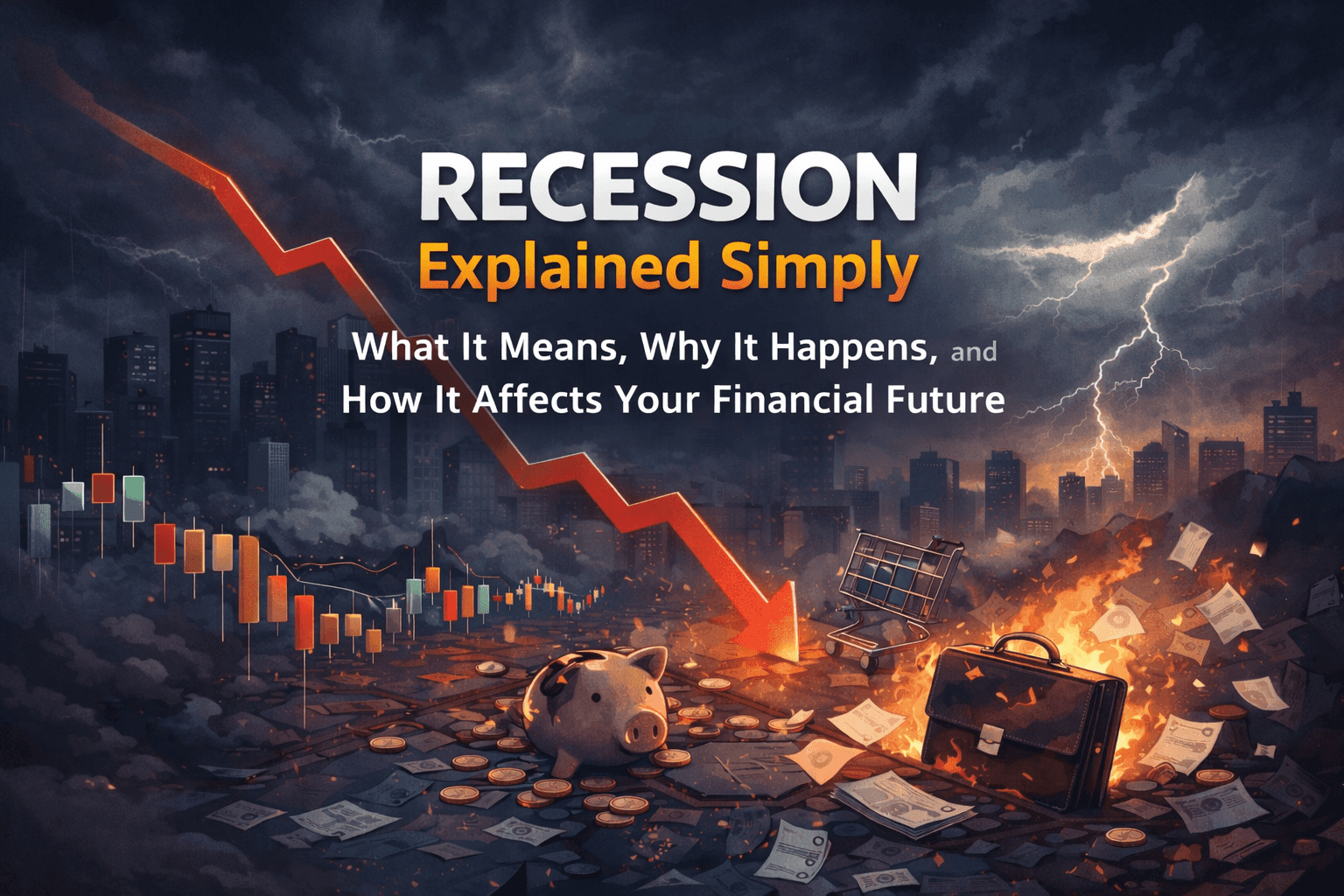
Recession explained in simple terms helps individuals understand how economic slowdowns impact jobs, spending, investments and financial stability. A recession reflects a decline in economic activity over time.
A recession is not just an abstract economic concept. It is a phase in the economic cycle where growth slows, uncertainty rises, and financial decisions become more critical. Understanding the meaning of recession, its causes, and its financial impact helps individuals make informed and disciplined decisions during uncertain times.
What Is a Recession?
A recession is defined as a period of declining economic activity lasting for at least two consecutive quarters, typically measured by Gross Domestic Product (GDP).
GDP represents the total value of goods and services produced within an economy. When GDP contracts:
- Businesses reduce production
- Consumer spending declines
- Economic confidence weakens
In simple terms, a recession is a broad-based slowdown in economic activity that affects multiple sectors simultaneously.
Key Features of a Recession
A recession is identified through a combination of economic indicators rather than a single event.
1. Decline in GDP
A sustained fall in GDP indicates reduced economic output and slowing growth.
2. Reduced Industrial Production
Businesses scale down operations due to lower demand, leading to decreased manufacturing and output.
3. Rising Unemployment
Companies cut costs during economic slowdowns, often resulting in layoffs and reduced hiring.
4. Decline in Consumer Spending
Uncertainty about income and job security leads individuals to reduce discretionary spending.
5. Stock Market Volatility
Investor sentiment weakens, causing market fluctuations and often a decline in stock prices.
These indicators collectively signal that an economy is experiencing stress and contraction.
Causes of a Recession
Recessions are typically the result of multiple economic pressures rather than a single trigger.
1. High Inflation
Rising prices reduce purchasing power, leading to lower demand for goods and services.
2. High Interest Rates
Central banks increase interest rates to control inflation. However, higher borrowing costs discourage spending and investment.
3. Global Economic Shocks
Events such as pandemics, geopolitical tensions, and supply chain disruptions can destabilize economies.
4. Financial System Instability
Banking crises, credit shortages, or excessive risk-taking can trigger widespread economic downturns.
5. Weak Demand Across Sectors
When both consumers and businesses reduce spending, economic growth slows significantly.
Historical Examples of Recession
Examining past recessions provides valuable insight into how economic downturns develop and impact economies.
The 2008 Global Financial Crisis
The 2008 crisis was one of the most severe recessions in modern history, triggered by the collapse of the US housing market.
Key outcomes included:
- Significant GDP contraction across major economies
- Millions of job losses globally
- Sharp declines in stock markets
India remained relatively resilient but experienced slower growth and reduced investment activity.
The COVID-19 Economic Slowdown (2020)
The COVID-19 pandemic caused a sudden and widespread economic disruption.
Key impacts:
- Negative GDP growth in multiple countries
- Severe job losses
- Decline in global trade
India’s GDP contracted by approximately 7.3% in FY 2020–21, reflecting the magnitude of the slowdown.
Recession vs Depression
While often confused, recession and depression differ in severity and duration.
- Recession: Short-term economic decline lasting months or a few years
- Depression: Prolonged and severe economic downturn lasting several years
The Great Depression of the 1930s remains the most extreme example, marked by widespread unemployment and economic collapse.
Financial Impact of a Recession on Individuals
Although recession is a macroeconomic phenomenon, its effects are deeply personal.
1. Income and Employment Risk
Job security becomes uncertain, and income growth may stagnate or decline.
2. Investment Volatility
Market fluctuations can impact portfolios, especially for short-term investors.
3. Changes in Spending Behavior
Households prioritize essential expenses and reduce discretionary spending.
4. Importance of Financial Planning
Emergency funds and disciplined financial habits become critical during uncertain periods.
How to Prepare for a Recession
While recessions cannot be avoided, their impact can be managed through proactive planning.
1. Build an Emergency Fund
Maintain savings covering 3–6 months of expenses to handle income disruptions.
2. Avoid Excessive Debt
High-interest liabilities can become difficult to manage during economic slowdowns.
3. Diversify Investments
A diversified portfolio helps reduce risk during market volatility.
4. Focus on Skill Development
Improving skills enhances employability and adaptability in uncertain job markets.
Key Takeaway
Recession explained simply is not just about economic decline—it is about understanding how cycles affect financial stability.
Periods of slowdown test:
- Financial discipline
- Preparedness
- Long-term thinking
Those who plan ahead are better equipped to navigate uncertainty.
Conclusion
Economic cycles are inevitable. Growth phases are often followed by contraction, and recessions are a natural part of this cycle.
However, awareness and preparation can significantly reduce their impact.
By focusing on:
- Financial discipline
- Risk management
- Long-term planning
individuals can navigate economic downturns with greater confidence and resilience.
Disclaimer
This content is for educational purposes only and does not constitute financial advice.












Post Comment