Introduction – Global Economic Outlook 2026 Overview
Global Economic Outlook 2026 highlights key global economy trends, recession risks, and GDP growth forecasts shaping financial markets worldwide.
The global economic outlook 2026 reflects a period of transition in the world economy. While global growth continues, the pace has moderated significantly, raising concerns around a potential global economic slowdown and increasing recession risk in 2026.
For investors, understanding the evolving global economy trends, economic growth forecast, and the interplay between inflation, interest rates, and global trade is essential. The insights provided by the World Bank’s Global Economic Prospects report offer a structured view of how the global economy is expected to evolve and what it means for financial markets.
Global Economic Outlook 2026: A Slower but Stable Growth Phase
The global GDP growth projection for 2026 is estimated at approximately 2.6%, indicating that while the global economy is expanding, it is doing so at a slower pace compared to previous growth cycles. This phase can be described as stable but not robust.
The current world economic outlook is shaped by multiple factors:
- Moderating inflation across major economies
- Tight monetary policies and elevated interest rates
- Gradual recovery in global trade
- Uneven growth across developed and emerging markets
This combination suggests that the global economy is not entering a crisis but is operating under constrained growth conditions. Such an environment often leads to cautious investment behavior and increased market volatility.
Key Drivers Behind the Global Economic Slowdown
Understanding the causes of the global economic slowdown is essential for interpreting market behavior and making informed financial decisions.
1. Inflation and Monetary Policy Impact
Inflation has been one of the most significant drivers of economic shifts in recent years. Although inflation levels are gradually declining, they remain above historical averages in many regions.
Central banks have responded with tighter monetary policy, increasing interest rates to control price levels. While this helps stabilize inflation, it also reduces liquidity and slows economic activity.
The impact of interest rates on markets is substantial:
- Higher borrowing costs reduce corporate expansion
- Consumer spending declines due to expensive credit
- Equity markets face pressure due to reduced valuations
2. Global Trade Trends and Supply Chain Adjustments
Global trade continues to recover but remains below pre-pandemic momentum. Persistent supply chain disruptions, geopolitical tensions, and trade restrictions have altered traditional trade flows.
The global trade trends indicate:
- Slower growth in cross-border trade
- Increased regionalization of supply chains
- Rising costs of logistics and production
These changes contribute directly to the economic downturn causes observed globally and affect both developed economies and emerging markets and developing economies (EMDEs).
3. Uneven Growth Across Regions
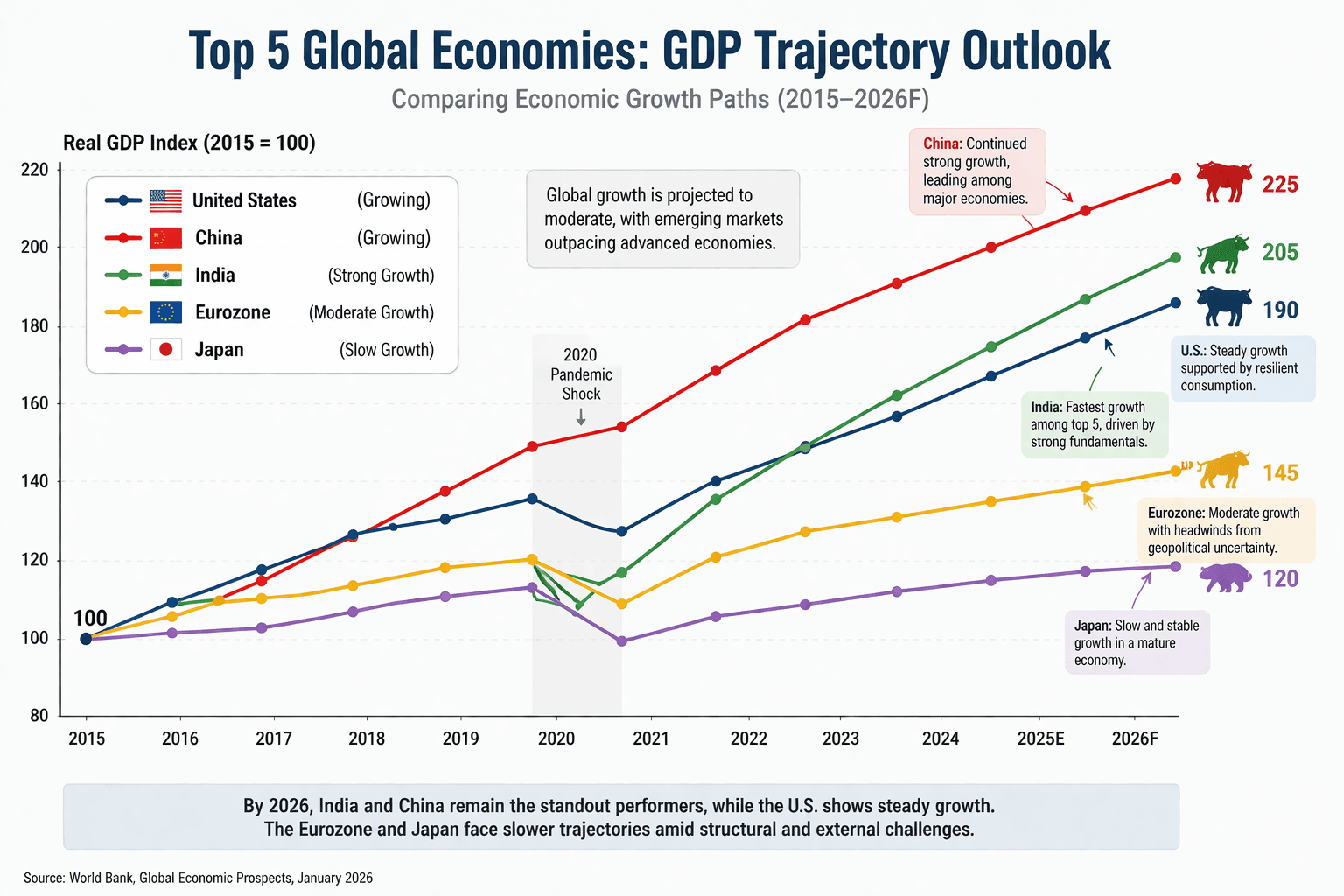
One of the defining features of the global economic outlook 2026 is the divergence between advanced economies and emerging markets.
While developed economies experience slow but stable growth, many emerging markets face challenges such as:
- High debt levels
- Currency volatility
- Lower capital inflows
This divergence creates a fragmented global growth pattern and increases overall uncertainty in the world economic outlook.
Recession Risk in 2026: Should Investors Be Concerned?
The possibility of a recession in 2026 remains a key concern for global markets. However, it is important to distinguish between a full-scale recession and a prolonged slowdown.
Indicators contributing to recession risk 2026 include:
- Slowing GDP growth
- Reduced industrial output
- Weak consumer demand
- Elevated interest rates
Despite these factors, the current outlook suggests a controlled slowdown rather than a severe contraction. However, the presence of external risks such as geopolitical conflicts, financial instability, and unexpected inflation spikes could alter this trajectory.
Impact of Global Economy on Financial Markets
The connection between the global economy and stock market behavior is direct and significant. Changes in macroeconomic conditions influence investor sentiment, capital flows, and asset prices.
1. Equity Markets
The impact of inflation on investments and rising interest rates tends to create pressure on equity valuations. Growth stocks, in particular, are sensitive to changes in discount rates.
2. Commodities and Energy Markets
Fluctuations in commodity prices, especially oil, play a crucial role in shaping economic outcomes. The oil prices impact on economy is evident through:
- Increased production costs
- Inflationary pressures
- Changes in trade balances
3. Currency and Capital Flows
Global uncertainty often leads to shifts in capital inflows, particularly affecting emerging markets. Investors tend to move capital towards safer assets during periods of instability.
How Inflation Affects Your Money and Investments
One of the most important aspects of the current global economy trends is inflation and its long-term effect on purchasing power.
The impact of inflation on investments in India and globally includes:
- Reduced real returns on fixed-income assets
- Increased importance of equity and real assets
- Need for inflation-adjusted financial planning
For individuals, understanding how inflation affects your money is critical for maintaining financial stability and achieving long-term goals.
Investing During Economic Slowdown: Strategic Approach
Periods of economic slowdown require a disciplined and structured investment approach. Rather than reacting to short-term volatility, investors should focus on long-term fundamentals.
Key Strategies:
- Focus on Quality Assets
Invest in companies with strong balance sheets and consistent earnings.
- Diversification
Spread investments across asset classes to reduce risk.
- Monitor Interest Rate Cycles
Understanding the impact of interest rates on markets helps in adjusting portfolio allocation.
- Avoid Emotional Decisions
Market fluctuations are common during slowdowns; disciplined investing is essential.
Emerging Markets vs Developed Markets: Where Opportunities Lie
The debate between emerging markets vs developed markets becomes particularly relevant in a slowing global economy.
Emerging Markets:
- Higher growth potential
- Higher risk due to volatility
Developed Markets:
- Stability and stronger institutions
- Lower growth potential
A balanced approach that considers both segments can help optimize returns while managing risk.
Why Understanding the Global Economic Outlook Matters
The global economic outlook 2026 is not just a macroeconomic concept—it directly influences everyday financial decisions.
From personal finance to large-scale investments, understanding the economic growth forecast, global trade trends, and monetary policy impact on economy allows individuals to make informed decisions.
It also helps in:
- Anticipating market movements
- Managing financial risks
- Aligning investments with long-term trends
The Bigger Picture: Structural Shifts in the Global Economy
Beyond short-term fluctuations, the global economy is undergoing structural changes driven by:
- Technological advancements
- Changing trade dynamics
- Policy shifts across economies
These factors are redefining how markets operate and how investors approach opportunities.
Understanding these structural shifts is essential for building a resilient and future-ready financial strategy.
Conclusion
The global economic outlook 2026 reflects a world economy navigating through a phase of moderated growth, persistent uncertainties, and evolving structural dynamics.
While the global economic slowdown raises concerns, it also presents opportunities for disciplined and informed investors. The key lies in understanding the broader economic context, analyzing market behavior, and maintaining a long-term perspective.
For a deeper and data-backed understanding of the global economy, readers are encouraged to refer to the full World Bank Global Economic Prospects report:
https://www.worldbank.org/en/publication/global-economic-prospects
Disclaimer: This content is for educational purposes only and does not constitute financial or investment advice.




Post Comment